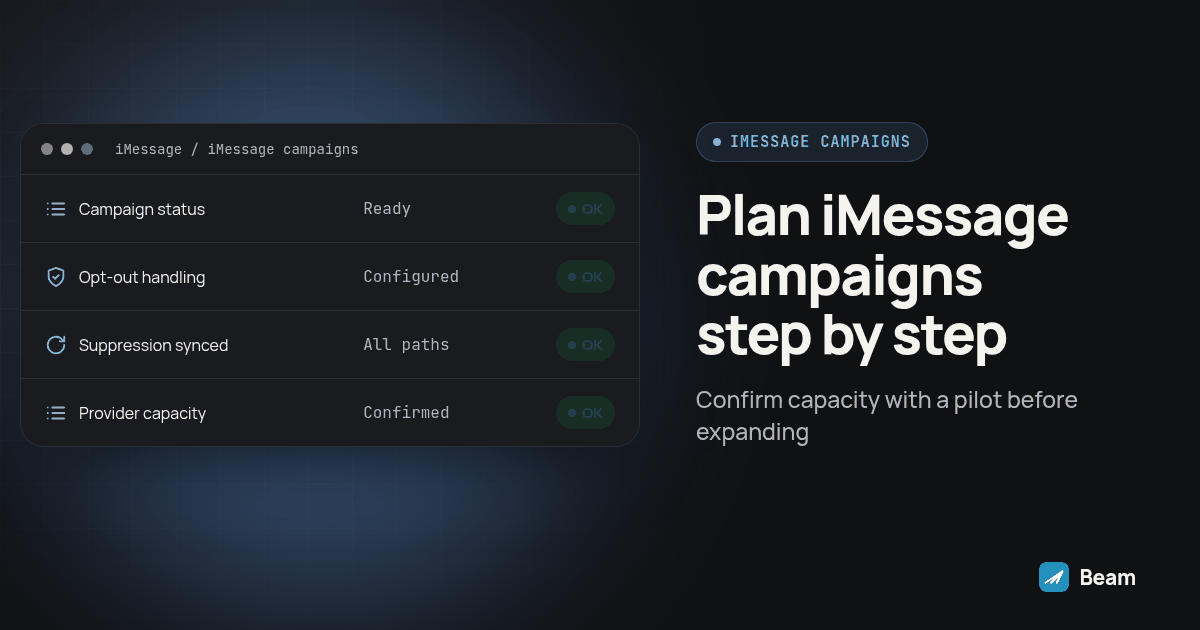
Bulk iMessage planning starts with permission and the actual route, not with an SMS messages-per-second figure. Apple does not publish a universal iMessage sending cap; agencies should confirm their provider’s available capacity and use a controlled pilot to assess the campaign workflow before expanding it.
Why doesn’t iMessage use the same A2P throughput caps as SMS?
A2P 10DLC is a carrier registration system for application-to-person SMS sent over eligible US long-code numbers. Twilio’s A2P 10DLC documentation describes campaign registration and throughput guidance for that carrier messaging route. iMessage conversations travel through Apple’s messaging service between supported Apple devices, so the carrier’s SMS allocation is not an iMessage capacity number. Beam’s iMessage sending limits guide likewise notes Apple does not publish a universal sending cap for business messaging.
That distinction answers only one question. It does not mean a sender can deliver an unlimited number of messages, guarantee a delivery time, or bypass consent and opt-out responsibilities. A plan, a sending queue, a carrier allocation and an Apple messaging conversation are different parts of the system. Confirm the capacity and conditions for the actual provider and route you intend to use.
For a mixed audience, also plan for recipients who are not available on iMessage. Beam supports iMessage, RCS and SMS, with the route depending on recipient and device support. The SMS leg remains subject to the relevant carrier requirements. A campaign estimate that counts every contact as an iMessage recipient can miss both routing and compliance work.
What does a published cap tell you, and what does it leave unanswered?
A published SMS rate can help estimate how quickly a provider may submit messages on a specified route. It does not by itself prove that an entire audience is eligible, that the campaign has enough remaining capacity, that all messages will arrive by a deadline, or that recipients have given permission. A2P throughput can depend on the registered campaign and provider conditions. Ask for the active limit that applies to the client’s route rather than borrowing a rate from a different account.
For iMessage, the missing universal public cap means the agency has to ask a different set of questions: what audience and line configuration are supported, what capacity is available for the planned send, how will the workflow report its status, and who reviews responses? Beam’s outbound texting page describes outbound messaging and mass outbound when budget allows. It does not publish a universal message rate for every account, so confirm capacity for the proposed campaign with the team.
| Planning question | Bulk SMS on a registered A2P 10DLC route | Bulk iMessage |
|---|---|---|
| Is there a universal public send rate? | No. Confirm the active allocation for the campaign and provider route. | Apple does not publish a universal per-second or daily iMessage allowance. |
| Which setup governs the route? | Brand, campaign, number type and applicable carrier requirements. | Supported iMessage route, assigned line, audience and provider capacity. |
| What should the agency request? | Written rate, shared limits, remaining capacity and reset conditions. | Written capacity guidance, line scope, status behavior and rollout expectations. |
| What should a pilot measure? | Queue behavior, message status, opt-out handling and replies. | Route and status behavior, replies, failures, opt-outs and recipient eligibility. |
| What does the pilot prove? | How the tested configuration behaved for the test audience. | How the tested configuration behaved for the test audience. |
Neither column supplies a delivery guarantee. Keep the route, audience and test conditions beside any estimate shared with a client.
What should an agency check before sending a large audience?
Begin with the reason each contact is on the list and the messages they agreed to receive. A contact record, an old purchase or a prior SMS campaign does not automatically explain what this particular iMessage campaign is about. Review the original consent language, collection source, purpose, channel, date and any revocation before including a person.
Next, separate the population into operationally useful groups. Contacts who recently started a conversation, customers receiving a requested update, and people in an older marketing segment may need different message context and review. Do not treat recency as permission by itself. Use the segmentation to select appropriate language, check eligibility and direct questions to an accountable person.
Set one suppression source that every connected campaign path checks before sending. Include STOP and ordinary language requests to stop, and decide how the team handles ambiguous replies. If several client subaccounts or workflows are involved, identify where suppression is stored and how changes are shared. Confirm the actual implementation instead of assuming a CRM or messaging provider syncs every list automatically.
Finally, ask the provider about the line and audience capacity, route behavior, reporting statuses and what happens when messages cannot use iMessage. If SMS fallback is part of the design, confirm its number type and registration or verification requirements. An iMessage plan does not answer questions about the fallback route.
How should an agency pace a bulk iMessage campaign?
Pacing should be a measured rollout, not a guessed universal threshold. This seven-step procedure gives an agency a repeatable way to gather evidence from a specific configuration. It does not claim a safe number of messages or promise that a provider will accept a particular campaign size.
- Write down the campaign scope. Record the client, intended purpose, audience segments, planned channels, sending lines, message versions, launch window and reply owner. List every automation that could contact the same person so the review covers the whole journey.
- Audit permission and suppression. For each segment, inspect the source and wording of permission, the purpose it covers, and any opt-out history. Remove records that are unclear or suppressed until the client resolves them. Retain a note explaining the inclusion decision.
- Confirm the route and capacity. Ask the provider to identify the lines, channels, available capacity, status reporting and fallback behavior for this campaign. For SMS, record the applicable number requirements and active carrier or provider limits. Keep the answer with the campaign plan.
- Prepare message variants for real context. Identify the business, explain why the recipient is being contacted, and provide a clear way to ask a question or stop. Variants should reflect meaningful differences in relationship or purpose, not small edits intended to disguise identical unsolicited messages.
- Run a controlled test with team-owned contacts. Use devices and accounts the team controls to check channel routing, rendered copy, links, replies, opt-out handling and CRM records. Save the status and observed result for each test case. Do not use this test as proof that a full external list will behave the same way.
- Pilot an appropriately permissioned segment. After internal checks pass, use a limited segment whose records have been reviewed. Monitor statuses and replies during the send, verify that suppression stops follow-ups across connected workflows, and pause when results differ from the written plan.
- Review evidence before expanding. Compare planned and actual routes, message statuses, failures, replies, opt-outs and staff coverage. Resolve unexplained results with the provider and client. Increase the audience only after the team can explain what happened and has capacity to handle responses.
Keep the worksheet and decisions for each rollout. A later send may use a different line, audience, message, channel or provider capacity, so the previous pilot is a reference rather than a guarantee for the next campaign.
How should opt-outs work across iMessage, RCS and SMS?
Make it possible for a recipient to stop messages without needing to guess a special keyword. 47 CFR 64.1200 describes revocation by reasonable means for covered calls and text messages and a period for honoring a request; agencies should review the applicable rule and state requirements with counsel. The operational design should make the request visible to the team, suppress the contact from queued and future campaign messages, and preserve a record of when the change occurred.
The same contact may appear in a CRM workflow, a scheduled campaign and a manual list upload. A suppression check limited to one automation leaves another path open. Test each connected path with a team-controlled contact: send the opt-out request, inspect the contact record, inspect pending work, and confirm that no other workflow sends afterward. Save evidence from the systems involved.
If a request arrives in ordinary language, define who reviews it and how quickly the campaign stops while it is interpreted. Avoid sending a promotional follow-up merely to ask whether the recipient meant to opt out. If confirmation is appropriate, keep it brief and do not restart the marketing sequence. Review Beam’s opt-out handling guide when mapping this process across channels.
What should the first message say?
The message should identify the business and connect the outreach to the reason the person is hearing from it. Use details the client can verify, avoid implying a relationship that does not exist, and provide a clear response path. A simple draft structure is:
Hi [first name], this is [business name]. You asked us about [specific service or update]. Reply here with a question, or tell us if you do not want further messages.
Use the bracketed reason only when the record supports it. Do not turn a broad list into a personal-sounding note that suggests a recent request when none exists. Test links and personalization against realistic records, including missing names and unexpected field values. If an SMS route is used, check the final rendered message and the carrier setup for that number type.
Choose a reply owner before the campaign launches. The person or team should know what they can answer, what needs escalation and how to handle a stop request. A send queue can finish while the client’s inbox accumulates unanswered questions, so include staff coverage in the rollout decision.
What should agencies know about consent and SMS fallback?
An iMessage conversation itself does not require A2P 10DLC registration. If a campaign uses SMS, registration and verification depend on the number type: local 10DLC numbers need A2P 10DLC registration, toll free numbers need toll free verification, and short codes need carrier approval. Those carrier steps do not replace consent review or suppression handling.
Avoid describing iMessage as a workaround for a restricted SMS campaign. The route should fit recipient eligibility, the permission record, the provider’s available capacity and the client’s service plan. Where the message purpose or permission is unclear, pause that segment for review instead of switching channels and assuming the issue has disappeared.
Agencies can also set expectations accurately: no public Apple throughput table does not mean an agency controls every part of delivery. Ask Beam about the campaign’s capacity and route, then document what is known and what still needs confirmation. Text the team with audience size, line count, channels, timing and reply coverage to scope a plan.
What do agencies ask before launching a bulk iMessage campaign?
Does Beam charge extra for a bulk iMessage campaign, or is it the same per-conversation plan?
Pricing is not shown here. Text our team with your audience size, the number of lines you plan to use, your channels, and your current texting workflow so the team can scope the campaign.
How long does it take to prepare a new iMessage line for a bulk send?
There is no fixed number of days to promise. Preparation depends on line readiness, the audience and permission records, the workflow, available capacity, and what a controlled test shows. Use the test procedure in this guide as a set of launch checks, not a calendar guarantee.
Does a bulk iMessage campaign need A2P 10DLC registration?
A2P 10DLC registration does not apply to the iMessage conversation itself. SMS fallback still follows the rule for its number type: local 10DLC numbers need A2P 10DLC registration, toll free numbers need toll free verification, and short codes need carrier approval.
What happens to our opt-out list if we switch from bulk SMS to iMessage?
Export and review the suppression records before changing tools. Carry forward every opt-out that applies to the planned messages, then verify the new workflow checks those records before it sends. A channel change is not a reason to treat a prior opt-out as a fresh permission.
Can we reuse the same list we built for a bulk SMS campaign for a bulk iMessage campaign?
Only when the permission record covers the messages and channel you plan to use. Review the original disclosure and purpose for each segment, carry forward opt-outs, and check channel eligibility before scheduling. SMS sending history does not establish permission for a different campaign.
Bulk iMessage campaigns need the same operational discipline as other client messaging: verify permission, understand the route, test the workflow, watch actual outcomes and keep suppression connected. For the voice follow-up side of an agency client journey, see RizzDial’s caller ID reputation guide. For messaging capacity, review Beam’s outbound texting guide and ask the team to scope the audience, line plan and reply coverage before launch.