TL;DR: A storm surge is a triage problem, not a bigger lead day. Acknowledge every inspection request by text within minutes, route active leaks ahead of routine quotes, collect claim photos as native attachments instead of emailed files, and run estimate follow-up on the claim stage, not a fixed day count. Size your sending line for the spike before the first hailstorm.
A hailstorm can compress inspection requests into a short window, putting pressure on a phone process designed for a steady flow. The NOAA Storm Prediction Center publishes storm outlooks and reports, which a contractor can use to monitor weather activity, not to forecast its own lead count. Texting gives the company a written way to acknowledge a request, ask a routing question and coordinate a later call. It does not guarantee a reply or a particular attachment format, so test the actual recipient channel and file type.
This is narrower than general home-service texting: roofing takes a multi-day spike tied to one weather event, a claim running alongside the sale, and a document trail both sides need weeks later. HVAC, plumbing and solar mostly don’t share that pattern. If you run several trades, the broader iMessage playbook for roofing, HVAC, plumbing and solar covers the shared structure; this guide goes deeper on the roofing-specific parts.
What makes a storm surge different from a normal day of roofing leads?
Volume may concentrate instead of spreading out, so a staffing plan based on an average week can miss a local event. Urgency is uneven: a reported active leak may need a faster response than a request for a cosmetic inspection, but a form fill does not tell you which until someone asks. Avoid giving insurance-timing advice unless a qualified person has reviewed the homeowner’s situation.
How should a roofing company triage a storm surge before the first text goes out?
Start by separating the storm-intake trigger from your routine lead trigger, so storm volume routes differently without hand-sorting every submission. Acknowledge a request promptly, before triage finishes, with an honest expectation rather than a promise the team cannot support. Then ask one qualifying question: active leak or no active leak. An active leak may need urgent mitigation, while a homeowner reporting exterior damage without an active leak may need an inspection booking. Have a qualified person make that call; the text workflow should route the answer, not diagnose roof damage. Capture the address and carrier name in that same exchange, for service area and carrier history.
Assign a named estimator to the thread instead of a shared inbox; a reply from a name lands better than one from a generic number. If the calendar is not settled, say when the estimator will follow up with an available window. Acknowledge the request without implying that an inspection slot is confirmed. Log a timestamp for both, so you know whether response time held as volume grew.
Sample text, storm-surge acknowledgment:
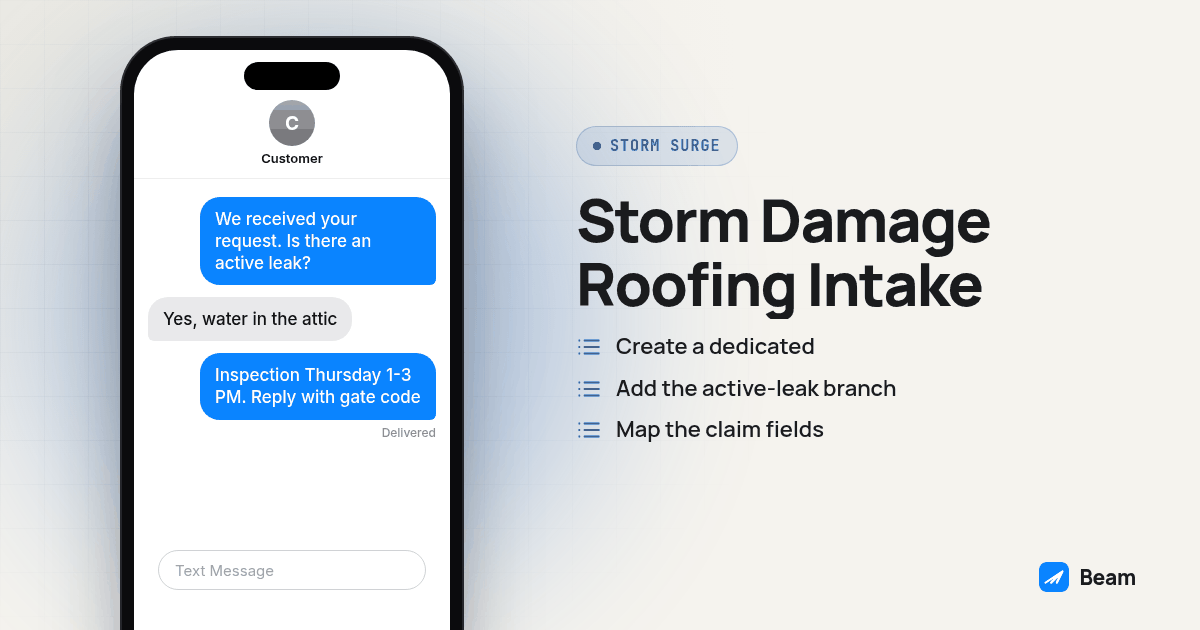
Hi Dana, this is [Company Name]. We’re reviewing storm damage requests in your area right now. One quick question: is there an active leak inside the house right now, or is this hail/wind damage with no active leak? Reply here and we’ll get you a time window today.
How do you text an inspection booking without turning it into another unanswered call?
Confirm an inspection the same way you’d confirm any appointment: specific time, what to expect, and an easy way to reschedule.
Hi Dana, your roof inspection is set for Thursday between 1 and 3 PM. [Estimator name] will walk the roof and take photos, you don’t need to be home but it helps if we can access the attic. Reply RESCHEDULE if that window doesn’t work, or call [company number] with questions.
Send the reminder the morning of, not the night before, since a surge schedule shifts as crews get reassigned to active leaks. If the window changes, update the same thread instead of opening a new one; a shifted time is tolerated far better than silence.
How should you collect insurance claim photos and documents over text?
A storm claim generates a document trail, photos, adjuster contact info, a claim number, sometimes a supplement, that both sides need weeks later. Attachment limits matter more here than on most jobs, since one inspection can produce a dozen photos. Attachment behavior depends on the recipient channel, file type and size. Do not promise a particular attachment count, file limit, compression outcome or delivery format without confirming the current sending route. Test a representative photo and document with a phone your company controls, then check what arrived and whether the recipient can open it. If the message becomes a hosted link or an attachment fails, use the relevant GoHighLevel or provider documentation to understand that route before making it part of the customer promise.
Request labeled photos in small batches instead of one open-ended “send pictures” text, and confirm the carrier and claim number when the homeowner has them. Send the estimate through a supported route and confirm receipt rather than assume it opened; see when GoHighLevel photos and PDFs arrive as links instead of attachments for checks worth running first. Keep the adjuster’s date in the thread too, so “did you talk to my adjuster yet” is one scroll up, not a phone call.
Sample text, claim document request:
Hi Dana, your adjuster is [Name] from [Carrier], claim #12345. Can you send a photo of the adjuster’s business card or the claim confirmation email so we have it on file? Also, if you have any photos of interior water damage, send those separately from the roof photos so we can label them correctly for the estimate.
How do you keep an estimate from going cold after the inspection?
Hi Dana, following up on the roof replacement estimate for [address]. Has [Carrier] scheduled your adjuster meeting yet? Once we know what they approve we can confirm your start date on the crew calendar.
How should a roofing team keep the thread useful through an insurance claim?
Treat the thread as a communication record, not the only place to store claim facts. The CRM should hold the current stage and responsible person, while the thread keeps the homeowner’s messages and replies together. Explain what information is useful and why before asking for documents. A homeowner may not have a claim number yet or may prefer an established secure intake process. Give them a reasonable alternative.
Avoid asking for more personal or financial detail than the team needs for the next step. If a document contains unrelated policy information, direct the customer to a channel the business has approved for that material. Make sure staff know who can access the conversation and how to handle a misdirected attachment. When the claim stage changes, update the CRM, assign an owner and stop any reminder that no longer matches the situation.
What does a full storm-to-signed-estimate stage map look like?
| Stage | Trigger | What you text | Attachment | Owner |
|---|---|---|---|---|
| Storm intake | Form, missed call or canvasser submission | Acknowledgment plus active-leak question | None | Triage lead |
| Inspection booked | Triage assigns a window | Confirmed date/time, reschedule option | None | Estimator |
| Inspection complete | Estimator logs the visit | Findings, next step | Damage photos | Estimator |
| Claim filed | Carrier + claim number known | Confirm carrier, claim number, adjuster | Adjuster card | Claims coordinator |
| Estimate sent | Scope finalized | Recap, ask about adjuster status | Estimate PDF | Estimator |
| Approved, unsigned | Carrier approves scope | Ask for signature, propose start date | None | Estimator |
| Signed, scheduled | Contract signed | Start date, prep instructions | None | Production |
| Supplement pending | Approval is short of cost | Status update, no action needed | Supplement docs | Claims coordinator |
| Job complete | Final inspection passes | Review ask, separate from invoice | None | Office |
How do you size and build this as a GoHighLevel workflow for roofing specifically?
- Create a dedicated storm-intake trigger separate from routine leads: a storm form, a canvasser submission, or a missed-call text-back.
- Add the active-leak branch as the first decision point: route “yes” to an immediate alert, “no” to the inspection queue.
- Map the claim fields (carrier, claim number, adjuster name and date) into custom fields, not free text, so the office sees claim status without re-reading the thread.
- Connect the Beam sending step through the Custom Webhook workflow integration, and dry-run it before a real storm list.
- Plan capacity before the storm: identify the number and channel that will send, expected message and reply volume, who owns the queue, and what the team will do if volume exceeds available capacity. Review Beam outbound texting and confirm the actual limits for the sending setup before launch.
- Watch reply rate as the health signal during the surge; replies dropping well below normal mean a line is about to get flagged.
- Assign a named backup for every estimator’s thread, since back-to-back inspections keep an estimator from answering in real time.
- Turn the workflow on for one zip code first, confirming triage and reply routing hold before the next event.
Diagram: storm intake branching on active-leak status into a dispatch alert or the standard inspection queue, then flowing through claim filed, estimate sent, approved and signed, each stage labeled with its owning role.
What should a roofing company know about TCPA and storm or insurance leads before sending?
Storm leads carry a consent risk routine referrals don’t: a meaningful share of storm-surge volume comes from purchased lists, canvassing apps or lead aggregators rather than a homeowner’s own form, and that’s where TCPA exposure concentrates. The FCC’s consumer guidance is a starting point for reviewing unwanted calls and texts. A name in a CRM does not by itself show what a person agreed to receive. Check the original disclosure, who collected the information, the business identified in the consent, the message purpose, and any later revocation before you automate contact. The precise legal requirements can depend on the technology and circumstances, so have the campaign owner consult qualified counsel when records are incomplete.
Also decide how the team will handle replies that do not fit the automation. A homeowner may ask for a call, report damage outside the service area, or ask the company to stop. The workflow should route those responses to a responsible person and stop any pending sequence when the contact opts out, books, or no longer qualifies. Keep this behavior in the acceptance test rather than relying on staff to notice after launch.
iMessage lines do not require A2P 10DLC registration. If an SMS route is configured for a contact, it follows the sending number’s own rules: a local 10DLC number needs A2P registration, a toll-free number needs toll-free verification. Twilio’s A2P 10DLC documentation covers that path. This is operational guidance, not legal advice.
Should you reactivate last season’s storm leads before the next event?
A homeowner who decided to wait last season, or went quiet mid-claim, isn’t automatically dead. If you have a backlog of inspected-but-unsigned roofs, segment it by what happened: waiting for an adjuster, reviewing an estimate, asking for a scope change or choosing to defer. A blanket “still interested?” note hides the reason the homeowner paused. A message that names the last agreed next step is easier to answer and gives the estimator a useful opening to correct a misunderstanding. Before reactivation, confirm that the original permission covers the planned follow-up and honor any opt-out recorded since the first inquiry.
Should a storm-surge lead get a text or a call first?
A text can acknowledge an inquiry and ask a short triage question, while a call can help a person discuss an active leak or a complicated estimate. Keep the call assigned to a person who can respond to the situation. For teams that want to coordinate messaging and AI calling, RizzDial provides the voice side of that workflow. Pair channels around the homeowner’s need: text for a written acknowledgment and next step, call for a conversation that requires judgment.
What do roofing contractors ask before switching their texting platform?
What does Beam cost for a roofing company during storm season?
Beam does not publish pricing on this page. A storm-week line plan depends on your expected contact volume, how many estimators need their own thread, and how many markets you run. Text our team with your typical storm-week lead count and we will scope it.
How long does it take to get a storm-intake text workflow live before the next hail event?
It depends on whether your CRM already fires a clean event on a new lead or missed call, whether your line is connected, and how many test leads it takes before triage and follow-up fire correctly. Build and test it in a quiet week, not the week a storm front moves through.
Does this work with JobNimbus or AccuLynx, or only GoHighLevel?
Beam connects with GoHighLevel through a Custom Webhook action. JobNimbus, AccuLynx and other roofing job-management software need a compatible API or webhook on their side; confirm with your provider whether their platform can call an outbound webhook when a stage changes.
Is it legal to text a storm lead list we bought from a canvassing or aggregator source?
A purchased or canvassed list is not automatically permission to text. Review what the person agreed to, who collected it, and whether that consent covers your business and message. Storm urgency does not change the requirement. Have the campaign owner confirm the record, and treat unclear consent as a reason to call instead.
We already text through a Twilio-based tool or our CRM’s built-in SMS. What does switching to Beam involve?
Confirm number eligibility and whether a port is needed, map your CRM triggers, carry over consent and opt-out records, and test sends and replies before cutover. Export any history you need first; porting a number does not bring its history with it. Agree on a rollback plan before retiring the old route.
Build the triage branch and the claim-document stage before the next storm front moves through your market. Text our team to try it against your own CRM and storm history before pointing it at a real lead list.