TL;DR: An iMessage line does not need A2P 10DLC registration, so a solar company can start texting aged leads and booking site surveys today while a separate SMS fallback number clears carrier review in the background. Consent still matters, especially on a purchased or aged list. Review what the person agreed to, who collected the record, and whether any opt-out has been recorded before building the workflow.
A solar company can use an iMessage line without waiting for A2P 10DLC registration, while a separate SMS route follows the requirements for its number type. Connect the line, map the CRM trigger, and verify sends and replies with test contacts before enabling a live workflow. An iMessage route can serve eligible iPhones; SMS fallback still needs its own registration or verification where required.
How can a solar company text aged leads and book site surveys without waiting on A2P 10DLC approval?
Solar leads sit on two different clocks. A fresh lead from this week’s ad needs a fast reply. An aged lead, one a setter bought at a discount or pulled out of a CRM after months of no contact, needs a different opener entirely, but neither should sit waiting on a number that has not cleared carrier review.
A2P 10DLC applies to 10-digit local SMS numbers, not iMessage. Toll free SMS numbers need their own verification step, and short codes need carrier approval, as Twilio’s A2P 10DLC documentation describes. An iMessage line uses a separate messaging route. The practical distinction is that a solar team can configure and test its iMessage workflow while an SMS fallback completes any registration or verification its number type requires. Confirm each route with test phones before sending a live lead campaign.
The registration process has separate business or brand and campaign steps, and approval timing depends on the submission and review path. Twilio’s registration guide explains that the campaign step follows brand approval; AWS’s 10DLC documentation publishes different estimated ranges for registration stages. Treat these as provider guidance, not a launch guarantee. Keep the iMessage workflow and SMS registration as separate work: iMessage does not use A2P 10DLC, while a local SMS fallback number may need it.
Why do aged solar leads need a different follow-up than a fresh web lead?
A fresh form lead has just asked to hear from the company, while an aged lead may not remember the original inquiry. A 2011 Harvard Business Review article reported findings from a study of online sales leads, including a relationship between faster contact and qualification; the article does not establish a solar-specific outcome or guarantee that a text will produce a response (Oldroyd, McElheran and Elkington, Harvard Business Review). For an older contact, identify the original inquiry and date as accurately as your records allow. Do not write as if the homeowner just submitted a form.
An older record is not automatically a reachable lead. Before building a campaign around it, check whether the source and consent record support contacting the person now, then decide whether the likely effort fits your team’s follow-up process. A message can remain in a conversation thread for someone to read later, but that does not mean they will see or answer it. Keep the opener honest: name the original interest, ask whether anything has changed, and give the recipient a clear way to decline further messages. That lets the team learn from replies and opt-outs instead of repeatedly sending the same generic follow-up. Our guide to reactivating a stale GoHighLevel database by iMessage covers the segmentation and pacing details for a list this old; the short version for solar is to filter by last activity and recorded consent before a single text goes out, not after.
What consent rules apply before you text a solar lead, especially one bought from an aggregator?
For any aged or purchased lead, start with the actual consent record and the way the contact was collected. Do not assume a list vendor’s general description proves that a person agreed to receive your company’s message. The FCC’s one-to-one consent rule adopted in 2023 was vacated by the Eleventh Circuit in 2025, and the court’s opinion explains why that specific restriction did not stand (Insurance Marketing Coalition v. FCC). That does not turn a vague record into permission. Keep the seller, message purpose, collection source, date and any later revocation available for review, and have qualified counsel assess an unclear campaign.
The FTC’s Telemarketing Sales Rule restricts covered telemarketing calls before 8 a.m. or after 9 p.m. at the consumer’s location, absent prior consent to a different time. Read the FTC’s current compliance guidance and have counsel determine which requirements apply to the campaign and channel you plan to use. Do not present the call-time provision as a universal text-message rule. The National Do Not Call Registry and state requirements can also affect a campaign depending on the facts. Review consent, suppression records, the source of an aged list and any revocation before sending; this is operational information, not legal advice.
How do you build a site-survey scheduling workflow over iMessage, step by step?
A site survey booking has more moving parts than a plumber’s appointment confirmation: financing status, a roof or ground-mount decision, utility paperwork, and a scheduling window that depends on which reps cover which territory. Build the workflow once, test it end to end, then turn it on.
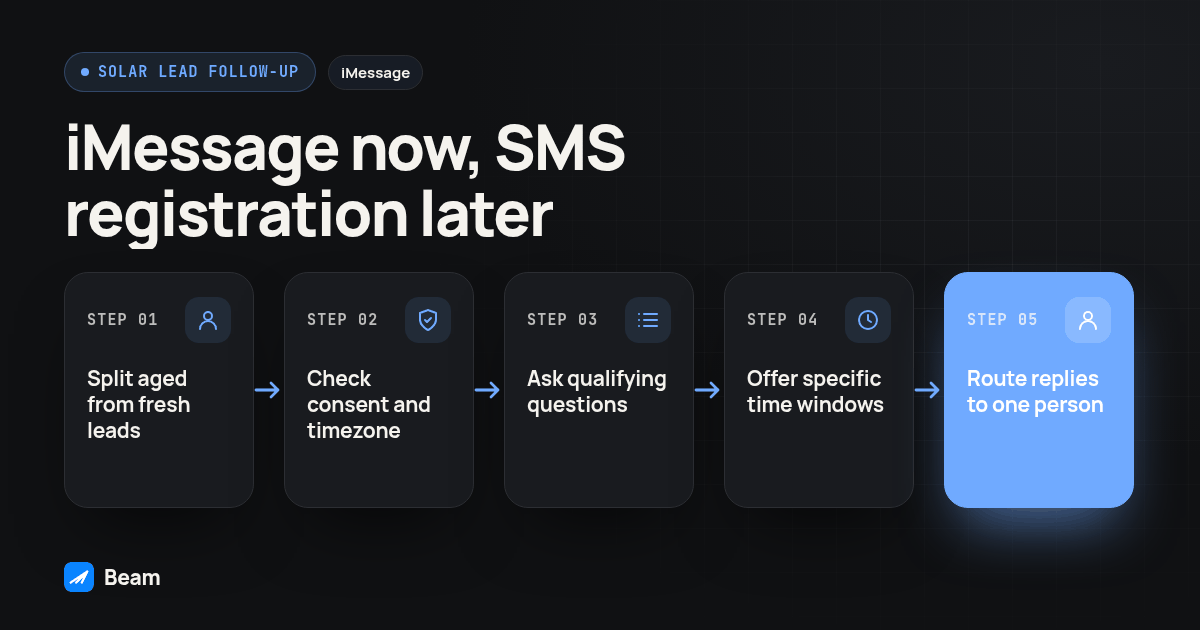
- Separate your aged-lead trigger from your fresh-lead trigger. A fresh form fill should hit a fast, direct opener. An aged lead pulled from CRM inactivity needs the re-engagement opener described above. Running both off the same trigger is how a fresh lead ends up getting the stale-sounding message.
- Confirm consent and time zone before the first send, not after a reply. Pull the consent record and the lead’s stated location into the workflow’s first step. Have the campaign owner confirm the applicable contact hours and consent requirements for the message and channel before a send, not as cleanup afterward.
- Connect the sending step through a Custom Webhook, following the same GoHighLevel workflow integration pattern used for other trade verticals, and dry-run it against a test contact before pointing it at a real list.
- Ask one qualifying question before offering a survey window: current electric bill range, roof age, or whether the property is owned, whichever your sales process actually uses to disqualify a bad fit. Route a disqualified answer to a short, polite close-out instead of a scheduling link.
- Offer two or three specific survey windows instead of an open “when works for you.” A specific window gets a faster reply and a cleaner calendar than an open-ended ask, and it gives the setter a direct YES/reschedule to react to.
- Confirm the booked survey the same day, and again the morning of, with the technician’s name and what to expect (roof access, panel location, how long it takes). Log a no-show or reschedule back into the CRM so the next message reflects reality instead of assuming the appointment held.
- Route every reply to a named person, not a shared inbox. A financing question or a “can you come earlier” request that sits unanswered for a day undoes the speed advantage iMessage gave you in step one.
Sample text, aged-lead re-engagement before a survey offer:
Hi Carlos, this is [Company Name]. You looked into solar with us a while back. Electric rates have moved since then and a lot of homeowners are taking another look. Want us to run updated numbers for your address, no obligation? Reply YES and we’ll get a site survey window out to you, or STOP to opt out.
Should iMessage, RCS or SMS carry the first message to a solar lead?
Channel availability depends on the recipient’s phone and carrier support, not on which one you would prefer to use, so plan for all three rather than assuming one will always be there.
| Channel | Who receives it | A2P 10DLC status | Right fit for a solar lead |
|---|---|---|---|
| iMessage | iPhone recipients only | Not subject to A2P 10DLC | First contact and ongoing nurture; highest-trust blue bubble thread |
| RCS | Android recipients on supported carriers and devices | Not the same registration path as 10DLC local numbers | Fallback with rich formatting (images of panel layouts) when the device supports it |
| SMS | Any phone, the universal fallback | Local numbers need A2P 10DLC; toll free needs its own verification; short codes need carrier approval | Confirmed-delivery fallback once the registered number is ready |
Route the first attempt through iMessage where it is available, let the platform fall back automatically when it is not, and keep the registered SMS number as the guaranteed catch-all rather than the default. That ordering is what lets a solar team start outreach the same week a new sales push launches instead of waiting on the slowest channel to clear review.
How do you keep a solar lead warm between the site survey and a signed contract?
The site survey is not the finish line for a solar deal the way it might be for a simpler home-service job; financing approval, utility interconnection paperwork, and sometimes a permit all sit between the survey and a crew showing up. Each of those stages is a place a lead goes quiet if nobody is texting them a real update.
Treat the thread as the running record the homeowner can scroll back through, while the CRM holds the actual stage and the responsible person. After the survey, send the proposal and ask a direct yes/no about financing preference rather than a generic “any questions?” When utility paperwork is the current bottleneck, say so plainly instead of leaving a silence the homeowner has to interpret on their own; “waiting on the utility” reads very differently from no message at all. The broader iMessage playbook for roofing, HVAC, plumbing and solar covers the shared workflow structure across trades if you run more than one; this guide goes deeper on the parts that are specific to solar’s longer, multi-stage sales cycle. Keep opt-out handling and your texting compliance obligations attached to every stage of that cycle, not just the first message, since a lead who opts out at the financing stage still has to stop receiving texts at every stage after it.
What do solar companies ask before switching their texting platform?
What does Beam cost for a solar company running a site-survey texting workflow?
Beam does not publish pricing on this page. Line count, aged-lead volume and whether you need an iMessage line plus a local or toll free SMS fallback change the setup, so the practical next step is to text our team with your monthly lead volume and how many reps or setters need their own thread.
How long does it take to get texting live if we are waiting on A2P 10DLC approval right now?
An iMessage line does not wait on A2P 10DLC registration, so it can be configured while a separate SMS number goes through its own registration or verification. The actual launch depends on line setup, CRM mapping and testing. Test delivery and replies on an iPhone and an Android phone you control before a real lead sees any of it.
Does this work with the solar CRM or proposal software our sales team already uses, or only GoHighLevel?
GoHighLevel can trigger Beam through a Custom Webhook action. Other solar CRMs or proposal tools need a compatible API or webhook integration and field mapping on their side. Confirm the send trigger, incoming reply handling and contact matching before rollout, since channel availability depends on the sender setup and recipient capability, not just which CRM you run.
Can we text an aged or purchased solar lead list the same way we text our own site-survey customers?
Not automatically. Check the actual consent record the list came with, who collected it, the message purpose and whether any opt-out has been recorded. Do not assume the list vendor’s general description proves permission for your campaign. Have a qualified person review unclear records before sending.
We already text leads through a Twilio-based tool or our CRM’s built-in SMS. What does switching to Beam involve?
Confirm number eligibility and whether a port is needed, then map your CRM triggers, carry over consent and opt-out records, and test sends and replies before cutover. Export any history you need first, since porting a number does not bring its message history with it. Agree on a rollback plan before retiring the old route.
Screenshot: a split-screen mock of one GoHighLevel contact record showing the aged-lead re-engagement text on the left and the booked site-survey confirmation text two days later on the right, with the consent-record field and time-zone field visible in the contact’s custom fields panel.
For the voice side of the same aged-lead push, see RizzDial’s guide to AI dialer lead nurturing for solar companies, which pairs calling with this texting sequence rather than replacing it. Text our team to try it with your own aged-lead list and we will walk through the trigger and consent setup together.