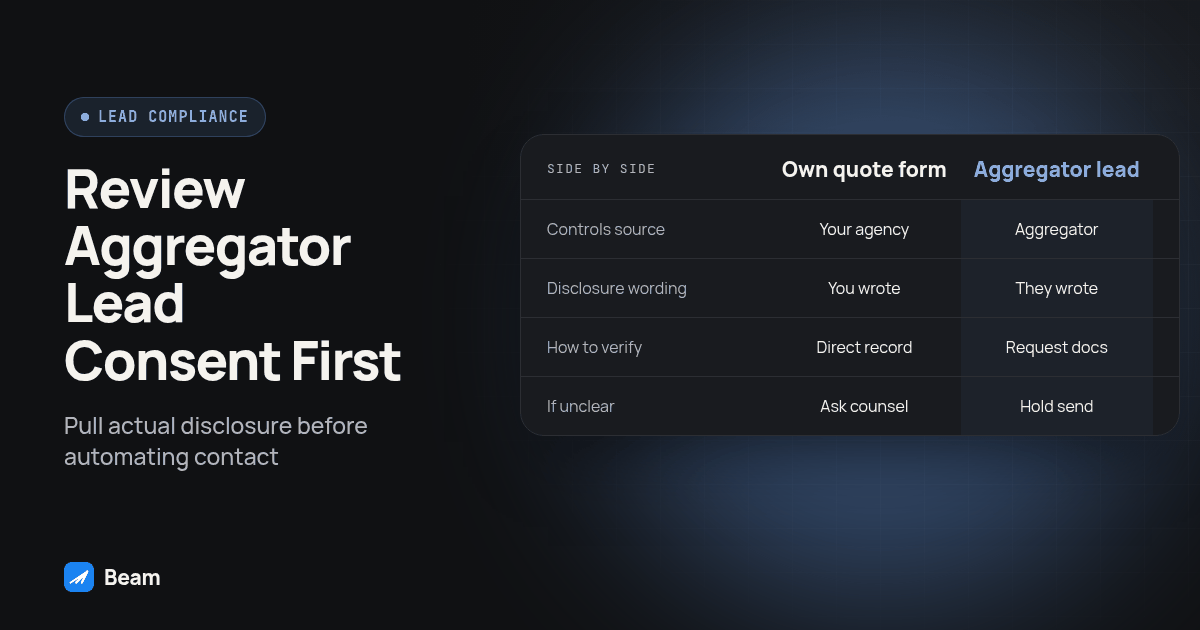
Before a purchased life insurance lead reaches a GoHighLevel or Beam workflow, review the actual consent language, the page where it appeared, the capture date, and the intended contact. If the record is incomplete or the scope is unclear, pause the automated marketing text and have compliance counsel review the facts. A broad aggregator certificate alone does not establish what the consumer saw or whether this agency may send this message.
In short: An aggregator certificate does not show by itself what the consumer saw or whether the planned message is covered. Pull the actual disclosure and submission record before the lead reaches an automated workflow. Route records cleared by your compliance review to the approved workflow, and hold incomplete or unclear records for review.
What makes an aggregator lead’s consent different from a lead off your own quote form?
A lead who filled out your agency’s own quote form submitted information through a form your agency controls. That gives you a direct record to review, but it still matters what the form disclosed, what the consumer selected, and which messages the agency plans to send.
An aggregator lead is secondhand. Someone filled out a form on a comparison site or a lead-gen company’s Facebook ad, and the aggregator later sold that lead to your agency along with some number of other buyers. The consent, if it exists, was captured by somebody else, in language you did not write. Review what the consumer was told, what contact they requested, and whether the disclosure covers the planned message.
This is a practical buyer question, not just a theoretical compliance issue: insurance-agent discussions include questions about contacting purchased leads and what third-party consent covers (public agent discussion). Forum posts can show what practitioners are asking, but they are not legal authority.
That distinction matters because of where the legal risk sits. Beam’s own compliance guidance puts it plainly: Beam “does not decide whether your list was properly sourced. A purchased list is a purchased list no matter how good the tooling is” (Beam’s consent guide). The platform will send the message if you tell it to. Whether sending it was allowed is a question only you can answer, and an aggregator’s say-so is not an answer by itself.
What should you look for in the consent record?
The TCPA and related rules can apply differently depending on the message, technology, number, and facts. Do not treat a lead vendor’s checkbox or compliance certificate as a universal answer. The FCC’s current rule addresses prior express consent and written consent in defined circumstances, and the Eleventh Circuit vacated the FCC’s 2023 one-to-one consent restriction in January 2025 (current eCFR text, parallel text at Cornell Law, court opinion). The secondary overview of the vacated one-to-one rule provides background on the litigation; rely on the current regulation and court opinion for the governing text. The court decision did not decide whether any particular agency may contact a particular consumer.
Review the specific disclosure the consumer saw, the form or page that collected it, the seller or sellers described, the requested contact methods and purposes, and the record tying that disclosure to this lead. Generic language such as “insurance partners” may leave important questions unanswered, but the legal effect depends on the full facts and applicable law. Ask qualified counsel to assess the agency’s campaign and workflow before sending automated marketing texts.
How do you check an aggregator lead’s consent before you send the first text?
Review a sample before launch, then make the record check part of intake for every batch. Vendor terms and consent language can change.
- Request the actual disclosure, not only a summary certificate. Ask the aggregator for the language the consumer saw, the page or form where it appeared, the submission date, and the record connecting those details to the lead.
- Check the stated seller, contact method, and purpose. Note references to “insurance providers” or “our partners” and whether the disclosure explains who may contact the consumer and how. Ask counsel to resolve ambiguity.
- Separate submission date from sale date. Record when the consumer submitted the form and when the lead was transferred. Those dates answer different questions.
- Route by review status. Records cleared for the planned contact can proceed through the approved workflow. Missing, generic, or unverifiable records stay out of automated sends until reviewed.
- Attach the evidence to the contact. Save the disclosure, source page, date, and review outcome where the team handling the lead can find them.
- Document the decision and owner. Record who reviewed the batch, which campaign and message the decision covers, and when to recheck the vendor terms or form.
Workflow: a lead enters intake, the consent evidence is attached to its contact record, then compliance review routes it either to the approved send workflow or to a hold queue for clarification. Both routes retain the source and review outcome.
How does an aggregator lead actually change the workflow, compared to your own form?
| Your own quote form | Aggregator lead | |
|---|---|---|
| Who controls the source form | Your agency can review and maintain it | The aggregator controls the form and its disclosures |
| What the disclosure says | Review the exact form and selection | Request the exact form and wording shown to the consumer |
| How you verify it | Retain the form, selection, and submission record | Request the source page, wording, timestamp, and lead-level record |
| What the transfer record proves | Your own collection and contact history | The vendor transfer, which may not establish the scope of consent |
| Workflow decision | Follow the reviewed consent and campaign rules | Hold until the evidence is reviewed for the planned contact |
| Evidence to preserve | Form version, selection, date, and source | Actual disclosure, source page, submission date, transfer record, and review |
| Follow-up if unclear | Ask compliance counsel to review the campaign | Keep the record out of automated marketing sends pending review |
How should the GoHighLevel and Beam workflow change for a purchased lead feed?
The Custom Webhook can send a lead through your connected Beam line (GoHighLevel workflow guide). For an aggregator feed, place the evidence review and a hold condition before that send action.
- Tag the lead source on import, something as simple as
lead_source: aggregator_name, set by your import step or a condition on the intake webhook. - Add a branch before the send step that checks the documented review status. Approved records proceed to the planned webhook action; missing or unclear records route to a hold queue with no automated marketing send.
- Keep the hold branch from sending. A short or neutral text can still be a marketing solicitation. Do not use an automated message to resolve a missing consent record.
- Keep
dry_run: truewhile you test both branches against contacts you control, confirmingstatus: validatedbefore you flip it to a live send. - Review replies, opt-outs, and delivery states separately by source. Pause the source if the signals suggest the records or workflow need review; do not treat engagement as proof of consent.
- Size your line count off the aggregator volume. Check each line’s current warm-up caps and use the pacing guidance documented for your Beam setup (sending limits). Do not increase volume simply because a vendor can deliver more records.
What should the first text say to someone who has never heard of your agency?
Do not imply the consumer submitted a request directly to your agency if the request came through an aggregator. If the planned contact is cleared, accurately name your agency and identify the source of the lead.
For a lead whose record and review support the planned contact, identify your agency and refer accurately to the source they recognize:
“Hey [first name], this is [agent name] with [agency]. [Comparison site] passed along your request for a [policy type] quote. Still looking for coverage, or did you already get this sorted?”
If the record does not establish that the agency may send the planned marketing text, do not use a text message to try to manufacture permission. Pause and ask compliance counsel to determine an appropriate next step.
A message that asks for permission can still be a solicitation, depending on its content and circumstances. Do not assume that sending a permission-check text cures a missing consent record. Keep any outreach on hold until your compliance review approves the basis and wording.
How do you handle opt-outs and quiet hours when you didn’t collect the consent yourself?
Treat an aggregator lead’s opt-out the same way you’d treat any other: immediately and completely. Beam’s consent guide describes handling common keywords and plain-language opt-out requests (Beam’s consent guide). The FCC rule recognizes reasonable methods to revoke consent and requires covered requests to be honored within a reasonable time, up to ten business days (current eCFR text). Treat an opt-out as a suppression request promptly, and check pending workflow actions and duplicate records. An opted-out contact is blocked at the send layer, which matters more on an aggregator feed, since the same consumer may show up again weeks later through a different vendor selling the same underlying list.
Quiet hours depend on the applicable rules and recipient location. Configure the workflow using the limits approved for your campaign and the recipient’s local time. Area code alone may not reliably establish a person’s current time zone, so use the location information your process is permitted to rely on.
The FCC’s revocation order described that outside timeline, and the current eCFR states that covered revocation requests must be honored within a reasonable time, not more than ten business days (FCC order summary, current eCFR text). Treat that as an outside limit, not a target, and suppress promptly.
What happens when the aggregator lead isn’t on an iPhone?
Beam checks the recipient and routes automatically: iMessage for eligible iPhones, RCS where the Android phone and carrier support it, SMS as the fallback otherwise (how routing works). The recipient’s device affects channel routing, not whether the agency has a valid basis for the planned contact.
The channel doesn’t change the consent question underneath it. SMS fallback still carries its own carrier registration requirements by number type: local 10DLC numbers need A2P 10DLC registration, toll-free numbers need toll-free verification, and neither substitutes for the underlying TCPA consent check. A lead with an unclear consent record remains on hold regardless of channel.
What should you test before turning this on for a live aggregator feed?
Run this on a small batch, or on contacts you control, before the full feed reaches real leads.
- Import a test lead using the aggregator’s real data format and confirm its source tag and record ID are retained.
- Attach a sample disclosure and submission record to the test contact, then verify the workflow can read the review status.
- Test the approved route with a phone you control and confirm only the intended message, channel, and contact record are used.
- Test the hold route with an incomplete record and confirm no automated marketing message is queued.
- Reply with an opt-out request from the test phone and confirm future workflow actions and duplicate records are suppressed.
- Test the approved local-time window and confirm the workflow holds messages outside it.
- Review delivery states, replies, opt-outs, and CRM history before deciding whether the feed is ready for a limited launch.
What do agencies ask about texting purchased life insurance leads?
Should an aggregator lead enter the same workflow as an agency form lead?
Only after the agency reviews the actual consent record and confirms that the planned contact is covered. If the record is missing or unclear, pause the automated marketing text and ask compliance counsel to review it before the lead enters the send workflow.
What should an agency save with each aggregator lead?
Keep the actual consent language, the page or form where it appeared, the submission date, the source, and the record connecting those details to the lead. A vendor certificate can be retained as supporting material, but it may not show what the consumer saw or whether the planned message is covered.
Does an aggregator’s compliance certificate settle whether we may text a lead?
No certificate should be treated as a universal answer. Review the actual disclosure, page, submission record, intended message, and applicable law. Ask qualified compliance counsel to assess the specific campaign before sending automated marketing texts.
Does changing from iMessage to SMS change the consent review?
No. A channel change does not resolve an unclear consent record. Beam may route to RCS or SMS when iMessage is unavailable, and SMS requirements depend on number type. Review the consent basis and carrier requirements that apply before enabling the workflow.
Where should you take this next?
An aggregator lead should enter an automated workflow only after the agency has reviewed the underlying record and approved the planned contact. Keep the evidence with the lead and make the hold route fail closed. The same ownership question can arise with calls and live transfers; RizzDial’s guide on owning your live-transfer leads instead of renting them covers that separate issue.
Start with Beam’s texting compliance hub for the regulatory backbone, see Beam’s outbound texting guide for pacing and line sizing once you know which leads are which, and the existing iMessage speed-to-lead workflow for insurance agents for the base GoHighLevel build this consent check sits on top of. Text our team to try it, bring one sample record, and we’ll help map the approved and hold paths before anything goes live.