Every agency that has set up white label iMessage for a client eventually asks the next question: now that it works, how do we actually get paid for it? That is a different question from how to build the client sub-account, which we cover in white label iMessage for GoHighLevel agencies, and a different question from how to pitch one client on the phone, which we cover in how to resell iMessage to your agency clients. This is the economics question: across your whole book of sub-accounts, which pricing model actually turns into profit, and which one quietly keeps you as the vendor your client thinks they are paying.
Start with how many eligible sub-accounts you run, then account for adoption, platform costs and support work. An agency with six client workspaces and an agency with sixty aren’t choosing between the same three models for the same reasons, even though the menu is identical.
What are the three real resale models, and how is this different from a sales pitch?
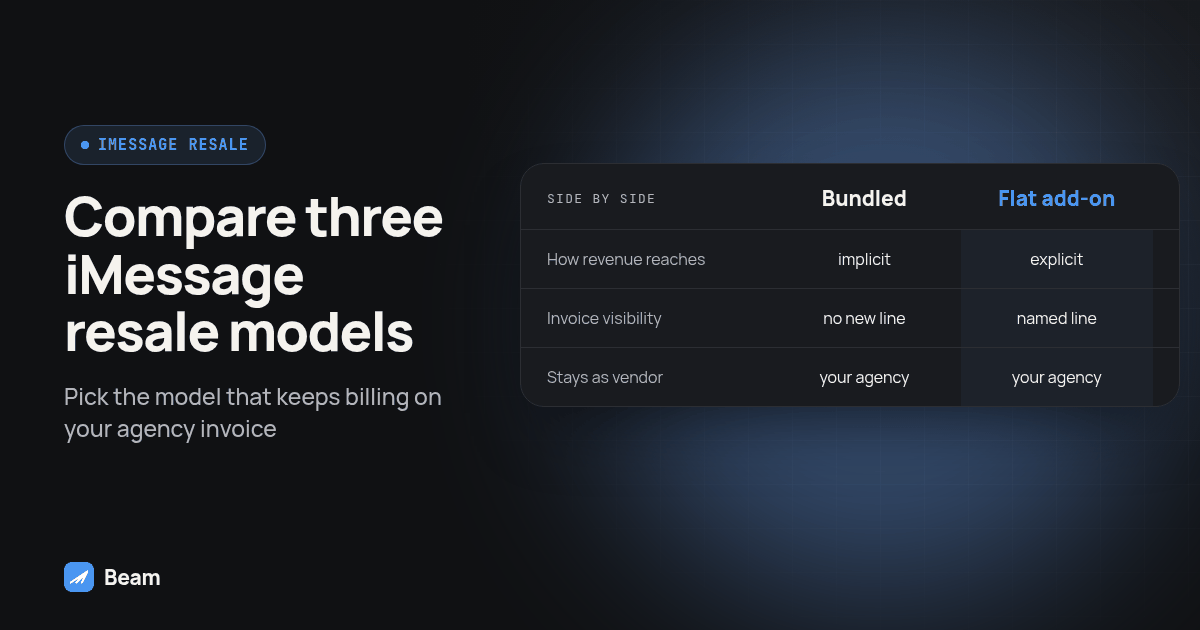
Strip away the vendor marketing language and you can compare three practical packaging structures for an agency service:
- Bundled into an existing package. No new line on the invoice. The client’s existing monthly retainer or managed-services fee quietly now includes blue bubble texting, RCS for supported Android phones and carriers, and SMS fallback.
- Flat monthly add-on. A named, separately priced line item that sits next to the existing retainer, visible to the client as its own thing.
- Usage-based, per-conversation or per-seat. The client pays based on how much the line actually gets used, whether that is conversation volume or the number of team seats reading and replying to it.
These are planning options, not a claim that Beam supplies all three billing mechanisms. Public vendor coverage confirms that agency branding is a real product category: iBluSend describes client portals under an agency’s brand and domain, checked October 25, 2026 (iBluSend’s white label answers page). How to resell iMessage to your agency clients already walks through how to pitch each one to a single client on a discovery call, with a pitch script and a per-client margin worksheet. This article treats the decision differently: as a portfolio call about your whole book of sub-accounts, not a single client’s invoice, and it asks a question the sales-script version doesn’t: which model actually leaves your agency as the client’s point of contact once the invoice goes out, and which one risks putting the underlying platform in that seat instead.
Who keeps the client relationship under each model?
This is the part that gets skipped when agencies price by gut feel, and it matters more than the margin math. Beam’s documentation is specific about where the client’s money actually goes today: the client owner signs in and pays Beam directly, even when an agency created the workspace, and that is the default billing path, not a workaround (Getting your numbers). A separate agency rebilling flow is documented for agencies that want their own branded checkout, but Beam’s own launch status note for that flow says not to enable it for a client until the agency payment connection, the checkout, and the cost protection have each passed a controlled test (Agency rebilling).
That fact changes what each model actually buys you:
| Model | How revenue reaches you | Who the client sees as the vendor | Typical fit |
|---|---|---|---|
| Bundled into existing package | No new invoice line; margin is implicit inside your existing retainer price | Your agency for its service invoice; direct platform billing can still create a separate bill | Clients already paying one flat fee for “everything,” where a new line item would invite renegotiation |
| Flat monthly add-on | A new named line on your existing agency invoice | Your agency for the add-on; disclose any separate direct platform payment | Clients who respond well to a clearly named service, and agencies that want to raise this one line later without reopening the whole contract |
| Usage-based, per-conversation or per-seat | Variable revenue tied to actual use, often metered on the platform side before it reaches your invoice | Depends on setup; if usage is billed through a separate per-unit checkout rather than folded into your invoice, the platform’s own billing screen can become the thing the client interacts with directly | High-volume clients (real estate, recruiting, mortgage) where a flat fee would badly over- or under-charge either side |
The practical rule: any model where you keep billing on your own agency invoice, whether that invoice amount is flat or recalculated monthly from usage you track yourself, keeps your agency visible for that service, but does not remove a separate platform bill. The risk shows up specifically when “usage-based” gets implemented as a direct pass-through checkout the client completes on the platform’s own page instead of a number you calculate and put on your own bill. Decide which implementation you’re actually building before you tell a client which model they’re getting.
How do you run the agency-wide resale worksheet?
Fill this in with your own numbers. A benchmark from a vendor’s blog post is built around that vendor’s cost structure, not yours, so treat any published range you find elsewhere as evidence a market exists, not a number to copy.
- Count your eligible sub-accounts. Of the client workspaces you run today, how many have a customer base where blue bubble texting or an Android RCS upgrade would actually be noticed? Write that number down; call it E.
- Pull your current average monthly price per client for whatever retainer or managed service this client already pays you for. Call that P.
- Pick one candidate model from the table above as your test case, not all three at once.
- Project adoption in three tiers: a small slice of E, a larger slice, and all of E. Multiply each tier by the incremental revenue you actually expect to collect. For an unchanged bundled retainer, incremental revenue is zero: assigning an internal value to texting does not create new revenue. Use P to check the remaining margin in that existing package.
- Subtract your real cost per account: your own platform cost for that workspace, plus setup labor hours times your loaded hourly rate, plus ongoing labor for assistant draft review and escalation handling. Text our team for a current cost quote on your own underlying plan before finishing this line, since that number changes by plan and by client volume.
- Find your breakeven count: how many of your E eligible sub-accounts need to adopt the add-on before the labor and platform cost of running it is covered. Separate fixed operating costs from recurring costs per adopting account. Divide fixed costs by positive contribution per account to estimate the count needed. If contribution is zero or negative, more accounts do not fix the model. Count onboarding labor under every model and spread one-time setup costs over a stated recovery period.
- Re-run the relationship-ownership check from the table above against your chosen model, specifically whether your implementation keeps billing on your own invoice.
- Pilot with one real client under the chosen model for one full billing cycle before rolling the same model out to the rest of E. Labor hours per client vary with how much hand-holding each one’s team actually needs, and that number only shows up once you’ve run it for real.
That sequence answers a different question than the per-client margin worksheet in how to resell iMessage to your agency clients: that one prices a single client’s invoice; this one tells you whether the model you’re about to standardize on actually scales across your whole book without losing money on the clients who barely use it.
What does a real objection sound like on this, and how do you answer it?
A useful buyer question to resolve before signing is: is the texting billed by GoHighLevel itself, or by the platform that sends the messages? It’s a fair question, since a client surprised by a second, unexpected bill starts asking what else is being charged twice. The honest answer, per Beam’s documented billing path: the texting platform, not GoHighLevel itself, is what the client owner pays for the workspace, on the platform’s own checkout, even when the agency built the sub-account (Getting your numbers). Your agency’s resale fee is a separate line on your own invoice for the setup, training and support work you’re doing. Say both parts out loud up front, rather than letting the client discover a second charge on their own.
Who should pick which model, and who should wait?
Bundling can fit clients who already pay for managed follow-up, provided the existing retainer covers the extra platform and support costs. A smaller portfolio does not automatically make bundling profitable. A flat add-on can fit clients who want a named service and a predictable invoice, provided the scope states how much training and ongoing support it includes. Usage-based billing can fit accounts with materially different workloads, but only if the agency can explain and verify the billable unit. Per-seat billing measures access rather than message activity, so do not assume it tracks operating cost. Choose from measured contribution and client expectations, not a universal sub-account threshold.
Hold off entirely if you haven’t connected a single client workspace yet; run white label iMessage for GoHighLevel agencies first. And hold off on usage-based pricing specifically if you can’t track per-client message volume accurately; you’ll eat the difference on your heaviest users.
What should you check before you price this across your whole book?
- Count your eligible sub-accounts (E) and your current average per-client price (P).
- Pick one model to pilot, not all three.
- Confirm whether your implementation keeps billing on your own agency invoice or routes the client through a separate platform checkout.
- Get a current cost quote on your own plan before finalizing a client price.
- Run the pilot for one full billing cycle before standardizing across your book.
- Put the export and number-transfer terms in writing before you need them, not after.
What do agencies ask about pricing this resale add-on?
Is the iMessage add-on billed through GoHighLevel, through the agency, or through the texting platform?
Beam’s documented direct-billing path has the client owner sign in and pay Beam, even when an agency created the workspace. Your agency can separately invoice for agreed setup, training and support. A combined agency collection arrangement requires separate configuration and verification. Do not promise one invoice until that arrangement has passed the documented payment and provisioning checks.
How long does it take to turn a live sub-account into a sellable line item?
There is no guaranteed setup or provisioning timeline. Confirm number availability, workspace access and the CRM connection, then test delivery and replies. Pricing the service is a separate decision: complete the worksheet, agree the scope with the client, and choose an invoice start date after the required launch checks pass.
Does reselling this add-on create a new A2P 10DLC wait for the client?
An iMessage line does not require A2P 10DLC registration. SMS fallback follows the applicable rule for its number type: local 10DLC numbers need registration, toll free numbers need verification, and short codes need carrier approval. That distinction does not guarantee immediate provisioning or remove consent and opt-out responsibilities.
Which resale model keeps my agency, not the platform, as the client’s point of contact?
Any of these models can keep your agency as the service contact if the contract, support process and invoice make that role clear. Bundled or flat billing does not hide a separate direct platform bill. Confirm who collects each charge, who answers billing questions and what the client sees before choosing a model.
What happens to this revenue line if the client leaves or switches agencies?
That depends on what you agreed to export and when the agency’s access gets removed, not on which resale model you picked. Settle in writing what the client gets if they leave: full message text or just a CRM summary, and who is the authorized party for any number transfer or port. We cover that handoff separately in who owns the number and text history after an agency split, because it is a contract question, not a pricing one, and it is worth answering before you sign the client, not during the breakup.
What’s the bottom line on pricing this for your whole book?
Pricing this add-on well is less about picking the “right” model in the abstract and more about matching the model to your current sub-account count and to how much you can actually track per-client usage. The bundled model can fit an existing managed service when its margin covers onboarding and support. The flat add-on protects agencies with clients who already expect named line items. Usage-based protects agencies with a few genuinely heavy users, provided you can actually meter them. None of the three is free money; all three still cost you platform fees and labor, which is why the worksheet above asks for your real numbers instead of a benchmark from somebody else’s blog.
If you haven’t built the underlying workspace yet, start with white label iMessage for GoHighLevel agencies for the setup steps, then come back here to price what you built. If you need the single-client pitch and objection answers rather than the portfolio math, how to resell iMessage to your agency clients covers that side. If you’re still comparing vendors before committing to any of this, which iMessage tool should a GoHighLevel agency choose lays out what each vendor’s own pages state on setup, rebilling and hardware. And the client sub-account itself, with its isolated inbox, numbers, assistant, team and CRM connection, starts at GoHighLevel iMessage for your client workspaces, which also carries the GoHighLevel page’s current add-on positioning if you’re running outbound calling for the same clients through RizzDial. Agencies doing both texting and calling resale for the same client base should also look at white label AI calling for resellers, which walks through the same ownership and pricing questions on the voice side.
Text our team to try it: /#interactive-demo.