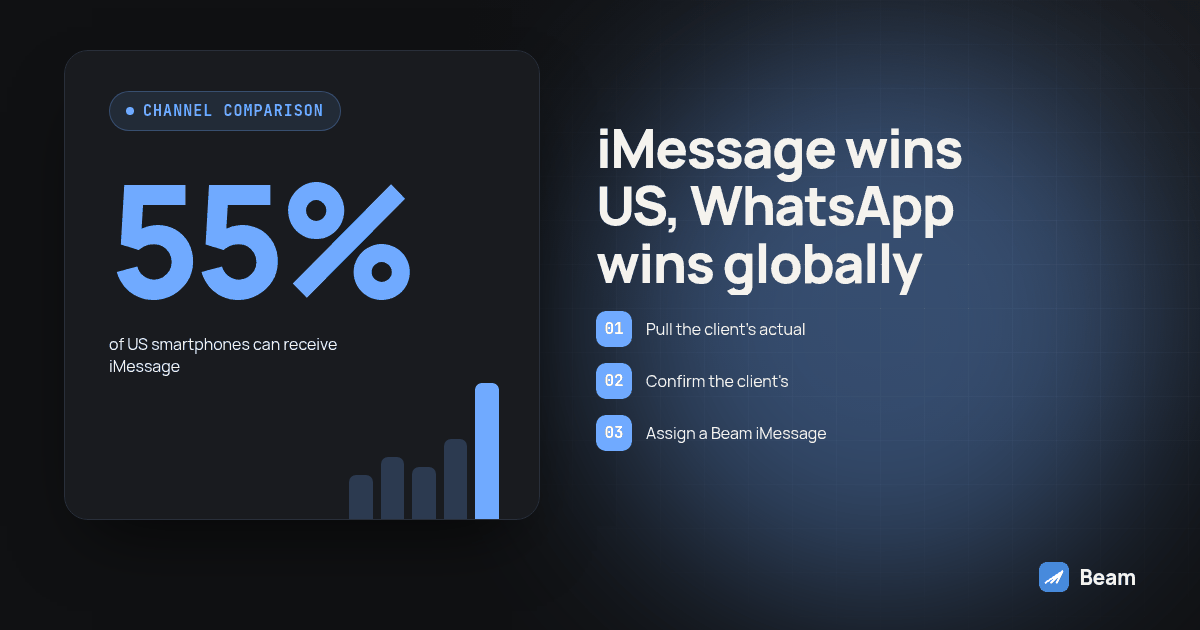
TL;DR: For a US-only client, set up an iMessage business line first; roughly 55% of US smartphones can receive it, against WhatsApp’s much smaller US footprint. For a client with real customers outside the US, especially in Latin America, Europe, India, or Southeast Asia, add a WhatsApp Business API connection, because that is where WhatsApp actually dominates. Plenty of clients need both running at once, on two separate connections, not one blended channel.
We get this question almost every time a new client’s customer list includes anyone outside the fifty states. The agency already knows iMessage well, usually from a past GoHighLevel build, and the client’s sales team heard “just use WhatsApp” from somewhere and now wants both. Below is how we actually decide, the real reach numbers behind that decision, a setup checklist for each case, and a short test to run before telling a client either channel is live.
Which channel should a US-focused agency set up first, iMessage or WhatsApp Business?
Start with where the client’s customers actually carry their phones, not with whichever app sounds more modern. For a US-only customer base, that is iMessage first, full stop. For a customer base with meaningful international volume, WhatsApp Business API earns its place, usually alongside iMessage rather than instead of it.
| iMessage business line | WhatsApp Business API | |
|---|---|---|
| Right for | US-based customers on iPhone | Customers outside the US, especially Latin America, Europe, India, Southeast Asia |
| Who can receive it | Eligible iPhones on a capable line | Anyone with the WhatsApp app installed, on any phone |
| Setup owner | Beam assigns the line and connects it to GoHighLevel | A WhatsApp Business Solution Provider handles Meta’s verification |
| Carrier registration | None; runs outside carrier A2P 10DLC | None from a US carrier; approval runs through Meta instead |
| Rich features | Read receipts, typing indicators, high-resolution media | Template messages, catalogs, and its own read-receipt system |
| Fallback for the channel’s own gaps | RCS or SMS inside the same Beam line | Usually SMS or email, since WhatsApp has no built-in fallback |
Notice what that table does not say: it does not say WhatsApp is worse, or that iMessage is the universal answer. It says the two channels solve different reach problems, and a channel decision made on vibes instead of the client’s actual customer list is the single most common mistake we see agencies repeat for a second and third client.
How far does each channel actually reach, and where do the real numbers come from?
A 2026 iMessage-versus-WhatsApp comparison estimates iMessage at roughly 55% of US smartphones, against roughly 35% of US adults for WhatsApp, and recommends exactly the split we use: iMessage for domestic outreach, WhatsApp for international audiences. A separate 2026 breakdown from Sinch lands close to that WhatsApp figure from a different angle, citing a Pew-style read of 32% of American adults using WhatsApp in 2025, up from 23% in 2021, which tells you the US WhatsApp number is real and growing, just still well behind iMessage’s share of the same market.
That same Sinch piece breaks the US WhatsApp number down by group, and the spread matters for a client with a specific customer base rather than a generic American audience. Hispanic Americans use WhatsApp at a 56% rate, by far the highest of any group Sinch tracked, with Asian Americans at 39% and Black Americans at 36%. If a client’s customer list skews toward any of those communities, the WhatsApp side of this decision gets stronger even before you look at where in the world those customers live. A real estate team working a bilingual market, or a home services company with a large Spanish-speaking customer base, is exactly the profile where “US-only” does not mean “iMessage-only.”
One more wrinkle worth flagging before a client leans hard on WhatsApp for US marketing: that same source notes Meta paused marketing template messages to US WhatsApp numbers starting April 1, 2025, which narrowed what a business can actually send to US WhatsApp contacts without a live conversation already open. That restriction does not touch iMessage at all, and it is one more reason a US-heavy client gets more immediate value from an iMessage line than from a WhatsApp campaign built on broadcast templates.
What does a US-only client’s setup checklist actually look like?
Run this in order. Each step either confirms a prerequisite or produces something you check before moving on.
- Pull the client’s actual customer list and check area codes against known international numbers. Do not assume “US business” means “US customers”; a national franchise or an online storefront can have a meaningful international tail even when the business itself is domestic.
- Confirm the client’s current CRM, usually GoHighLevel, and whether a texting line already exists. A client switching from a different provider needs that history reviewed before a new line goes live, not after.
- Assign a Beam iMessage business line to the client’s workspace, with its own inbox, numbers, and CRM connection, so the new line never touches another client’s conversations.
- Connect the GoHighLevel location with a restricted credential, scoped to contact and calendar access only, and confirm Beam shows the account as connected before building anything on top of it.
- Add the Custom Webhook step to the relevant workflow, pointed at the assigned line, and run it with
dry_run: truefirst so nothing sends while you are still wiring the automation. - Send one real test message to a phone you control, confirm it arrives as iMessage and not a silent SMS fallback, and confirm the reply lands on the same CRM contact.
- Set the SMS fallback behavior for recipients who cannot receive iMessage, since even a US-only list will include some Android phones and some iPhones with iMessage disabled, and that fallback still carries its own carrier registration requirements depending on the number type.
That checklist gets a US-only client live on one channel with one provider. It is also, not coincidentally, close to how we onboard any new Beam client regardless of the WhatsApp question, because the iMessage side of a mixed setup does not change just because a second channel is coming later.
What changes the moment a client has customers outside the US?
Everything about the setup stays the same for the US side, and a second, entirely separate setup gets layered on top for the international side. That second setup is not something Beam provides directly; Beam’s channel lineup is iMessage, RCS where the recipient’s phone and carrier support it, and SMS fallback, and WhatsApp Business API sits outside that lineup. For the international leg, a client works with a WhatsApp Business Solution Provider, completes Meta’s business verification, and builds out message templates separately from anything running through GoHighLevel’s existing SMS action.
The practical result for an agency is two parallel connections feeding one client relationship, not one unified inbox. The iMessage side keeps running through the iMessage API and the Custom Webhook pattern already described above. The WhatsApp side runs through its own provider’s API, its own templates, and its own delivery reporting, and the two systems generally do not share a contact timeline unless someone builds that bridge by hand. Tell the client that up front. A sales conversation that promises “one inbox for every customer everywhere” sets an expectation neither provider meets on its own.
Compliance also splits cleanly along the same line. iMessage runs outside carrier A2P 10DLC entirely, and SMS fallback still carries whatever registration applies to that specific number type, covered in more depth in our RCS, SMS, and iMessage comparison. WhatsApp has no A2P 10DLC exposure at all, since it never touches the SMS carrier network, but it has its own separate rulebook through Meta, including the opt-in and template requirements that govern what a business can send and when. Treat them as two compliance tracks, not one.
Does a client ever genuinely need both channels running at once?
Yes, and it is more common than agencies expect once they actually look at a client’s full customer list. A mortgage team with a mostly domestic book of business but a handful of international buyers, a home services company serving a bilingual metro area, or an ecommerce brand that fulfills internationally are all candidates for running iMessage and WhatsApp side by side rather than picking one.
The decision rule we use with agencies is simple: segment the list first, then pick channels per segment instead of per client. A client is not “an iMessage client” or “a WhatsApp client.” A client has a US segment that should get iMessage, and maybe an international or Spanish-speaking segment that should get WhatsApp, and treating the whole list as one audience is how agencies end up sending the wrong channel to a sizable chunk of their own customers. Outbound and mass texting covers the budget and sending-capacity planning once a segment is confirmed; do that math separately for each channel, since WhatsApp’s template restrictions and iMessage’s pacing considerations do not scale the same way.
Watch for a specific trap here: a client who asks for WhatsApp because a competitor uses it, without actually checking whether their own customer base lives in a market where WhatsApp wins. We would rather tell a client “your list is almost entirely US iPhone numbers, WhatsApp will not move your reply rate” than build a second channel nobody’s customers will ever open. Review Beam’s channel coverage in the provider comparison before telling a client why one provider handles the US side and a separate provider handles WhatsApp.
How do we test the channel decision before we commit a client’s rollout?
Do not trust a gut read on a client’s customer base. Run this sequence on a sample before committing budget to either channel.
- Pull a random sample of 50 to 100 contacts from the client’s actual list, not from a sales deck describing the target customer.
- Check area codes and any stored address or billing country field for a rough domestic-versus-international split.
- Send a test iMessage to five US numbers you control on the newly assigned Beam line, confirming blue-bubble delivery before touching the live list.
- If the sample shows a meaningful international segment, open a WhatsApp Business API trial with a provider and send a test template to a number you control in that market, not to a live customer.
- Compare reply behavior, not just delivery, on both channels over a short pilot window, since a delivered message that nobody answers is not a working channel.
- Confirm each channel’s opt-out handling separately, since a WhatsApp opt-out and an iMessage or SMS opt-out are two different consent records, and a lead who stops one channel has not automatically stopped the other.
- Only then roll the full list, split by the segment you actually measured, not by the split you assumed going in.
That sequence catches the two failure modes we see most: an agency assuming a client’s customer base skews more international than it does, and an agency assuming a domestic client has zero international tail when a handful of customers quietly do. If the same workflow also hands a hot lead to an AI calling tool once a reply comes in, test that handoff separately; RizzDial’s integrations page documents what a connected dialer or voice agent actually needs from the CRM side before it can pick up where the text left off.
Where does this leave an agency onboarding its next client?
Stop treating “iMessage or WhatsApp” as a single company-wide decision. Pull the actual customer list, check how much of it is genuinely international or skews toward a community where WhatsApp already wins, and size the two channels against that real data instead of a hunch. A US-heavy client gets an iMessage business line and nothing else, most of the time. A client with real international volume gets that same iMessage line plus a separate WhatsApp Business API connection, run as two systems that happen to serve one customer relationship. Either way, run the test sequence above before the client ever sees a channel go live, and keep the compliance tracks separate in your own head so neither registration requirement gets skipped.
Text our team to try it on a contact you control before you roll either channel out to a client’s full list.
What else should you know before choosing?
How long does it take to stand up both an iMessage business line and a WhatsApp Business API connection for the same client?
An iMessage business line through Beam uses a workspace setup: assign the line, connect the GoHighLevel location, and send a test message. A WhatsApp Business API connection follows a separate timeline set by Meta and the chosen provider, including business verification, so plan the two connections separately and do not promise a client both channels on the same go-live date.
Does WhatsApp Business API require the same A2P 10DLC registration as SMS?
No. A2P 10DLC is a US carrier rule for application-to-person SMS sent from local ten-digit numbers, and it does not apply to WhatsApp, which runs over Meta’s own messaging network rather than the SMS carrier path. WhatsApp Business API has its own separate verification process through Meta, and a client’s SMS registration status tells you nothing about whether their WhatsApp number is approved.
If a client already pays for WhatsApp Business API, is it expensive to add an iMessage business line alongside it?
That depends on volume and number count, which is a scoping conversation rather than a published rate. Text our team with the client’s expected send volume and number of lines, and they will put a number on it before anything goes live.
Can one GoHighLevel workflow trigger an iMessage send and a WhatsApp message from the same automation?
A single workflow can branch into both, but they are two different sends through two different connections, not one unified channel. Beam’s Custom Webhook step handles the iMessage, RCS, and SMS branch; a WhatsApp Business API provider handles its own branch separately, and the two providers do not share delivery status or a single contact timeline unless you build that sync yourself.