TL;DR: Pick the channel by recipient, not by preference: iMessage reaches eligible iPhones on a capable line with no carrier registration of its own, RCS reaches supported Android phones but needs carrier-approved sender verification, and SMS is the fallback almost everyone can receive but it carries the heaviest compliance load (A2P 10DLC, toll-free verification, or short code approval, depending on the number type). Most real customer lists are a mix of all three, so the channel decision that matters is the fallback order, not a single winner.
Agencies ask us this question almost every week, usually right after a client asks why part of their list got a green bubble and the rest got a blue one. The honest answer is that “RCS vs SMS” is really three separate questions stacked on top of each other: what can the recipient’s phone receive, what has the sender registered, and what happens automatically when the first two don’t line up.
Which texting channel should a business actually use for a customer?
The channel is not really a choice you make once per campaign. It is a decision made per recipient, every time, based on what that specific phone and carrier can accept. Here is how the three channels compare from the sender’s side.
| Channel | Who can receive it | What the sender must set up | Richness | Where compliance load lives |
|---|---|---|---|---|
| iMessage | Eligible iPhones on a capable line | Nothing carrier-side; the line itself must support it | Read receipts, typing indicators, high-res media | Consent and opt-out handling, not carrier registration |
| RCS | Android phones whose phone and carrier both support it | A verified sender or agent profile, approved by the carrier | Read receipts, rich media, branding where the implementation supports it (Google’s RCS for Business overview) | Carrier-level approval with no fixed turnaround guarantee |
| SMS | Nearly any phone that can receive a text | Registration tied to the number type: A2P 10DLC, toll-free verification, or short code approval | Plain text without rich cards | Heaviest and most standardized compliance load of the three |
Rich Communication Services (RCS) is a GSMA-developed standard built as a successor to SMS and MMS. It carries read receipts, typing indicators, high-resolution media, and richer group chat over IP rather than the old circuit-switched SMS path, and it works over mobile data or Wi-Fi where SMS does not need either. Apple says RCS on iPhone requires iOS 18 and a network provider that supports it, so an RCS-capable iPhone is another recipient category alongside Android. That matters for anyone still mentally sorting every customer list into “iPhone equals iMessage, Android equals something else.”
What does a business need to set up before it can send SMS?
SMS carries the most paperwork of the three channels, and it is tied to the number type rather than the channel itself. A local ten-digit number sending application-to-person SMS needs A2P 10DLC registration. A toll-free number needs toll-free verification instead. A short code needs its own carrier approval process. None of those three requirements goes away because a business also happens to send iMessage or RCS from the same workspace; each number type carries its own obligation, checked separately.
We wrote a longer breakdown of exactly where RCS approval does and does not substitute for this SMS paperwork in Does RCS Business Messaging Replace A2P 10DLC?, including the specific layers (carrier registration, sender verification, and device support) that agencies tend to collapse into one step when they shouldn’t. It does not replace it: RCS and SMS are different sending routes with distinct setup requirements.
What does a business need to set up before it can send RCS?
A verified sender, and carrier patience. Twilio’s own announcement of RCS messaging reaching general availability is specific about this: a business creates an RCS Sender and submits compliance information, and “while all brands can submit RCS Senders for carrier approval, Twilio cannot provide an SLA or guarantee Sender approval by carriers.” That is a materially different promise than A2P 10DLC’s defined registration process. SMS registration has a known submission and review path. RCS sender approval is discretionary at the carrier level, which means the honest answer to “how long will this take” is “longer than SMS, and we cannot promise a date.”
The upside, when approval comes through, is a richer conversation: Google’s own description of RCS for Business lists rich media, branding, and read receipts as available capabilities, though which of those an implementation actually exposes depends on the platform behind it. Review RCS business messaging for agencies before promising a client any specific RCS feature; a verified brand profile and a rich-card campaign builder are not automatically included just because a line can send RCS.
What does a business need to set up before it can send iMessage?
This is the part that surprises people, because there are actually two different things called “business iMessage,” and they require completely different setup.
Apple’s own enterprise product, Apple Messages for Business, is a registered program. Apple’s own program documentation requires a business to register with Apple and work through an Apple-approved Messaging Service Provider, and the business is identified by an Apple Business ID rather than a phone number. Customers reach that business through a specific entry point Apple controls, like a website button, a Maps listing, or a Wallet pass, not by texting a number they already have saved.
Beam’s approach is different, and it is the one most agencies actually need: a dedicated business number that sends iMessage directly to eligible iPhones, the same way a person’s personal number does, just from a line your team manages. That path does not require an Apple Business ID or an approved Messaging Service Provider, and it does not require any carrier registration either, because iMessage is not an SMS route in the first place. What it does require is a capable assigned line and a recipient whose phone can actually receive iMessage from a number it hasn’t seen before.
Knowing which of those two products you are actually buying matters before a client signs anything. A procurement requirement naming “Apple Messages for Business” wants the registered program with the Business ID. A requirement for “text our customers from our own number” wants what Beam does. They are not interchangeable.
What happens when the recipient’s phone can’t use your first-choice channel?
It falls back, automatically, in a fixed order, as long as the workflow is actually wired to check. Beam’s own documented routing logic checks the recipient’s capability and the selected line’s support before choosing a channel: iMessage for eligible iPhones on a capable line, RCS for Android phones whose phone and carrier both support it, and SMS fallback for other reachable recipients, with SMS fallback remaining subject to whatever carrier registration applies to that line’s number type. Twilio describes essentially the same shape from its own side of the SMS and RCS world: messages attempt RCS delivery on capable devices, then automatically downgrade to SMS or MMS when needed.
Two details matter more than the headline fallback order. First, the first number a recipient hears from is sticky: once a contact has a number, every reply and follow-up keeps using that same number, so the fallback decision happens per message, not per contact, and a contact’s channel history can genuinely be mixed over time. Second, an uncertain delivery is not the same as a failed one. A workspace can turn on automatic SMS retry after a confirmed failed iMessage, but an ambiguous provider update does not trigger that retry on its own; a teammate reviews it instead. Treat “no clean delivered status” as a reason to check the record, not a reason to assume the fallback already fired.
How do you test which channel a real customer will actually get before rolling out to the full list?
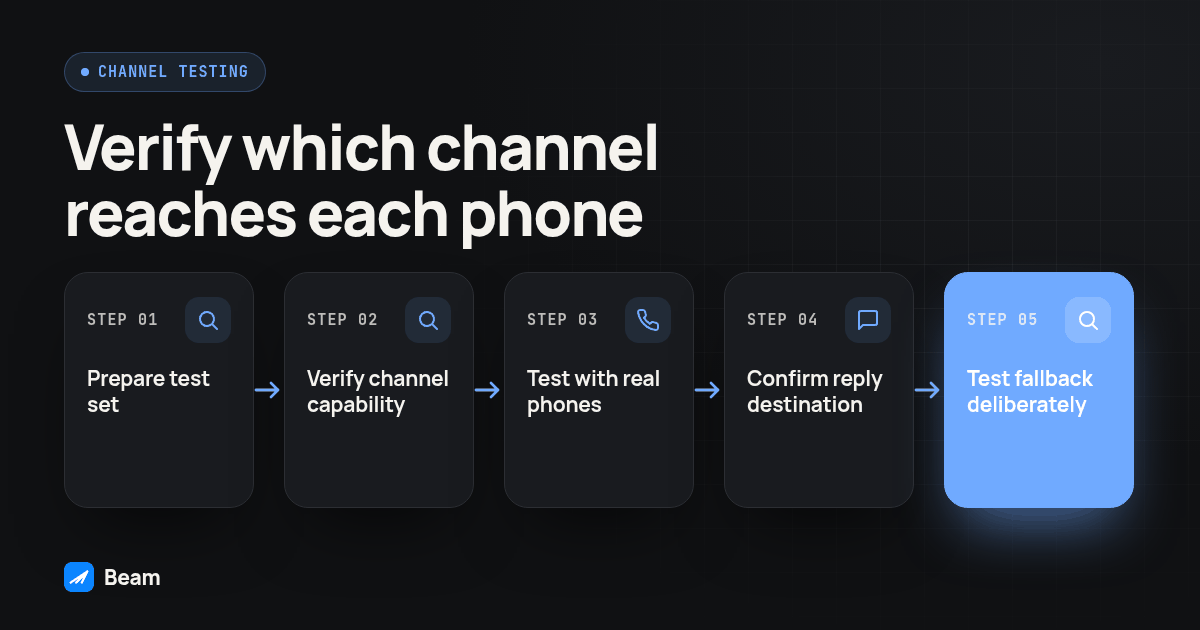
Run this on contacts you control before a channel-aware send ever touches a live list.
- Pick one iPhone number you know is iMessage-eligible. Confirms the blue-bubble path fires before anything else matters.
- Send a test message and record the channel Beam reports, not the one you expected. Queued or sent is not proof of delivery; wait for a delivered or confirmed-failed result.
- Reply from that test phone and confirm it lands on the same contact record. A reply that creates a second contact means the handoff is broken.
- Repeat the send on an Android number you control. This exercises the RCS-or-SMS branch, the step most teams skip once the first test passes.
- Check what channel the Android test actually used. RCS and SMS can look similar in a quick CRM glance; confirm the specific channel.
- Send to a number with no messaging capability, like a landline. Confirm the system reports a failure rather than queuing forever.
- Trigger the same contact twice with an identical message. A retry after a timeout should not text the customer twice; confirm the second attempt is recognized as a repeat.
- Only then connect a small segment of the real list, not the full list, and watch its channel mix before expanding.
Each step checks a different failure mode: wrong channel, false delivery confidence, broken contact matching, and duplicate sends. If the workflow also hands a lead from text to an AI calling tool such as RizzDial, test that handoff separately before using it on a client list.
Which workflow steps should default to iMessage, RCS, or plain SMS?
That depends on whether the step behaves like a conversation or a blast, which is a separate question from whether a channel is technically available. We cover the step-by-step version, including which specific GoHighLevel action invokes channel-aware routing versus which one quietly bypasses it, in iMessage or SMS in GoHighLevel: Choosing by Workflow Step. The short version that applies outside GoHighLevel too: a warm, one-to-one first touch or a reminder to a known contact benefits from the richer channel and the reply it might get. A one-way service alert to an entire client base, where no individual reply is expected, is one of the few places where a plain SMS path is a defensible choice rather than a missed opportunity. That linked guide covers exactly how to wire a Custom Webhook step to do it.
What should an agency check before promising a client “we text your customers over iMessage, RCS, and SMS”?
Four things need confirming, in this order, before any client-facing promise gets made. First, confirm the recipient list’s real device mix: do not assume every lead with an Apple-sounding area code has an iPhone, and do not assume every Android user’s carrier supports RCS, so test reachability instead of guessing from the contact record. Second, confirm which SMS number type is in play, since a local number, a toll-free number, and a short code each carry a different registration requirement, and the client’s existing number may already be mid-registration under a different vendor. Third, confirm the RCS sender, if one is in play, is actually approved rather than merely submitted; submission is not approval, and Twilio’s own general-availability announcement is explicit that approval timing is not guaranteed. Fourth, confirm consent and opt-out handling exists on every channel, not just the primary one, because a channel decision does not create permission to contact someone; that permission still has to come from how the contact opted in.
What do agencies actually ask us about RCS, SMS, and iMessage setup?
Does sending over iMessage mean our business skips A2P 10DLC registration completely?
No. A2P 10DLC applies to application-to-person SMS sent from local ten-digit numbers. Toll-free numbers and short codes have their own carrier requirements. iMessage is a separate channel, but a workflow that uses SMS fallback still has to meet the requirements for its SMS number type.
How many texts can one business line send in a day before it gets flagged?
There is no single daily number that applies to every carrier, number type, and messaging route. Check the requirements for the specific sender and channel, and pace an initial rollout so you can review delivery, replies, and opt-outs before expanding it.
Can I rely on a fixed RCS sender approval timeline?
No universal timeline applies. The approval process depends on the RCS provider and carrier. Google documents distinct Google-managed and carrier-managed launches, while Twilio says it cannot guarantee carrier approval or a timeline. Confirm the current requirements and status with the provider handling the sender before setting a launch date.
Does an SMS registration automatically transfer when we change providers?
Before switching providers, verify registration and number ownership with the current provider and the carrier. Registration and phone number portability are separate questions, and a platform change does not by itself establish that a registration transfers or that the same number can be used. Get written confirmation of what remains in place before planning a cutover.
Does RCS and SMS fallback work inside GoHighLevel the same way iMessage does?
Not through GoHighLevel’s standard Send SMS action. Beam’s GoHighLevel guide documents a Custom Webhook path for channel-aware sending. Verify the configured endpoint and test the recipient route, reply, and CRM record before relying on it in a live workflow.
Where does this leave a business planning its next text?
Stop asking “RCS or SMS” as if it were a single setting. Ask instead: what does our recipient list actually look like, what has our sending number already registered, and what happens the moment the first-choice channel doesn’t land. Get those three answers before a client call, and the channel question mostly answers itself. Outbound and mass texting is the right place to plan the full rollout, including the budget and sending-capacity conversation that channel choice alone doesn’t settle.
Text our team to try it on a contact you control before you roll this out to a client’s full list.