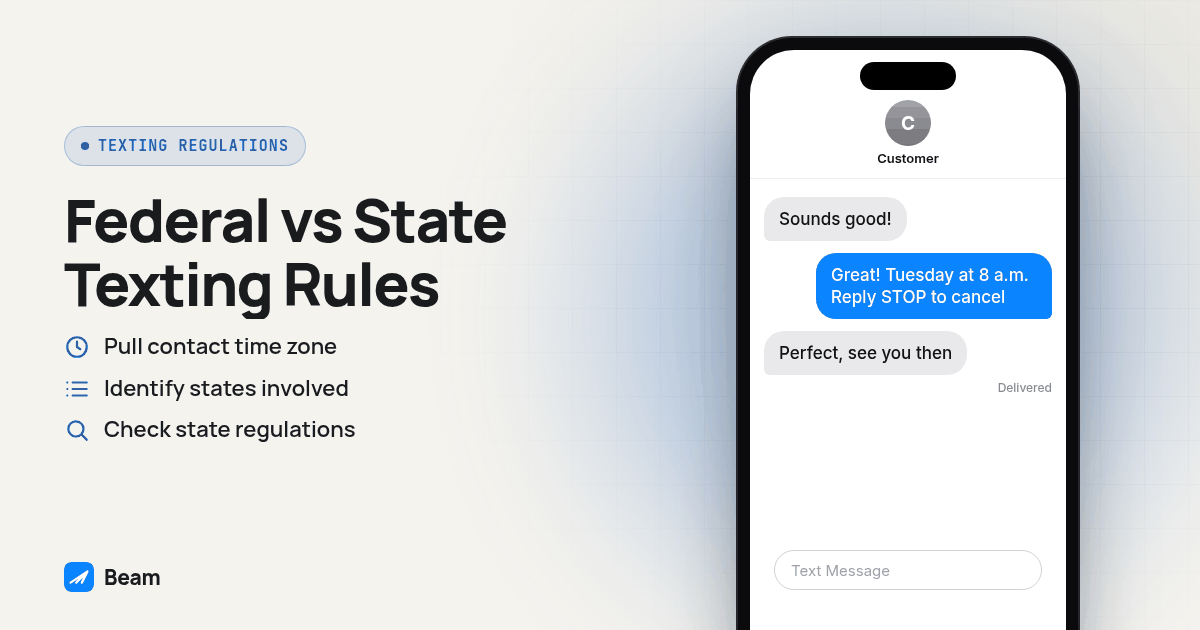
TL;DR: Under the federal TCPA, marketing texts can only go out between 8 a.m. and 9 p.m. in the recipient’s local time, not yours (47 CFR 64.1200(c)(1)). Some states cut that window shorter. Florida’s cited commercial telephone solicitation phone-call provision closes at 8 p.m.; use that earlier cutoff as a conservative texting policy while counsel confirms coverage (Fla. Stat. 501.616(6)(a)). Schedule every send against the recipient’s time zone and the tightest rule that applies to them, not the time zone where your team sits.
Consider this scheduling mistake: someone sets a text campaign to their own office hours and never checks where the list lives. The campaign can look fine on the sender’s clock and fall outside the applicable window on the recipient’s. This guide covers which hours are legal and how to keep automations inside the window.
This is general compliance information based on the statutes and FCC rules cited below, not legal advice. Have counsel review your campaigns, consent language, and state exposure before you launch.
What Hours Can You Legally Text Under the Federal TCPA Quiet Hours Rule?
The federal floor is 8 a.m. to 9 p.m., measured in the recipient’s local time, for telephone solicitations under the Telephone Consumer Protection Act (47 CFR 64.1200(c)(1)). Telephone solicitation concerns encouraging a purchase, rental or investment in goods, property or services, with exclusions in the regulatory definition. Paragraph (e) applies the relevant protections to wireless calls and texts. Counsel should confirm campaign coverage and any claimed exception; the timing rule is not a blanket ban on every business text.
Thirteen hours is wide on paper, which is why teams get comfortable and stop checking it. The rule cares about the clock where the phone is sitting when the message lands, not what your office hours or platform’s dashboard default to. A dashboard that displays only the sender’s clock can hide a recipient-time scheduling error. Check the local time before releasing a message, including one held in a queue.
For TCPA consent, revocation, and the ten business day window for honoring a stop request, see our guide to TCPA texting rules for business. This article stays narrowly on timing.
Why Does the Recipient’s Time Zone Control the Window, Not Yours?
Because the rule exists to stop someone’s phone from buzzing before they are awake or after they have gone to bed, regardless of where the sending business happens to be. A send that looks reasonable on the sender’s own clock can land before 8 a.m. or after 9 p.m. for a recipient in a different time zone.
Here is a worked example during Eastern daylight saving time, using Phoenix for the Arizona contact. An agency schedules a campaign for 8:30 p.m. Eastern. A contact in Arizona gets it at 5:30 p.m. Arizona time, fine, and a contact in Hawaii gets it at 2:30 p.m. Hawaii time, also fine, both comfortably inside 8 a.m. to 9 p.m. locally. Push that same campaign to 9:15 p.m. Eastern and Eastern-time recipients fall outside the federal window, while Pacific recipients receiving the identical blast at 6:15 p.m. local are still fine.
Is Florida’s Quiet Hours Window Really Shorter Than the Federal Rule?
Yes, for the commercial telephone solicitation phone calls covered by the cited provision. Florida sets its own quiet hours at 8 a.m. to 8 p.m., not 8 a.m. to 9 p.m. (Fla. Stat. 501.616(6)(a)), a full hour shorter on the back end than the federal rule most teams build their scheduling logic around.
A marketing calendar can be built entirely around the federal 9 p.m. cutoff, with no separate rule for any state. A marketing text sent at 8:30 p.m. local time to a Florida recipient misses that earlier operational cutoff. The cited statute expressly addresses phone calls, so this guide uses 8 p.m. as a conservative Florida texting policy, not a conclusion that every SMS is covered by that provision. Have counsel assess the seller, message and applicable law. The federal rule sets the floor, and a state is free to require more.
How Does Florida’s Window Compare to the Federal TCPA Rule?
| Federal TCPA | Florida | |
|---|---|---|
| Rule | 47 CFR 64.1200(c)(1) | Fla. Stat. 501.616(6)(a) |
| Earliest legal send | 8 a.m. recipient local time | 8 a.m. recipient local time |
| Evening cutoff | 9 p.m. recipient local time | 8 p.m. recipient local time |
| Applies to | Telephone solicitations (marketing calls and texts) | Covered commercial telephone solicitation phone calls; confirm text coverage |
| Controls for a Florida contact | Sets the federal floor, not the governing cutoff for Florida contacts | Use earlier texting policy pending coverage review |
Treat that bottom row as the operating rule for every state: a narrower window governs. The federal rule never gives you permission to text later than a stricter state allows.
Do Other States Set Their Own Texting Quiet Hours?
Some do, and we are intentionally not listing specific hours for any state beyond Florida, because getting this wrong in print is worse than leaving it out. State telemarketing statutes change. The pattern we can confirm: state consumer protection law sits on top of the federal TCPA floor, and some states narrow the window, add consent requirements, or both.
The safe operating rule is to treat the federal 8 a.m. to 9 p.m. window as the maximum allowed, then check the statute for every state with a meaningful number of contacts. If a state has not published a narrower rule, confirm that, do not guess it.
How Do You Calculate the Right Send Time When Your List Spans Multiple States?
Segment first, then calculate the permitted window for each contact. One national send time can work when all applicable windows overlap. A single office-time setting, however, does not establish that overlap or keep a later retry within it.
Take a list with Florida, other Eastern-time, Central-time and Pacific-time contacts. A midday Eastern send may fit every segment, while an 8:30 p.m. Eastern send misses the conservative Florida cutoff for Miami. Florida also includes Central-time locations, so the state field alone cannot identify the recipient’s clock.
Tag each contact with a confirmed time zone and applicable state rules. Use separate schedules or a verified shared overlap. Hold contacts whose location cannot be established instead of silently assigning them the agency’s time zone.
What’s the Step-by-Step Process to Keep Automations Inside the Window?
Run this procedure before any recurring text automation goes live, and repeat it whenever a new state is added.
- Pull the governing time zone for every contact. Confirm the current time zone with the recipient where possible. Use the service or billing address as a starting point, not proof of present location. Flag any contact without an address for manual confirmation.
- Identify every state represented in the list. A campaign cannot be scheduled safely until you know which states it touches.
- Look up the current quiet hours statute for each state on the list. Confirm the statute text at schedule time, since state rules get amended.
- Record the tightest applicable window for each segment. Use 8 p.m. local as the conservative Florida texting cutoff pending coverage review. Other segments follow the federal floor unless a stricter rule applies.
- Set each segment’s send time in its own local time, not the time zone where the campaign was built. Split the list by governing window if your tool only accepts one send time.
- Build in a buffer before the edge of the window, so a delayed send from a queue backlog or retry does not slide past the line.
- Test the schedule with a dummy contact in each represented time zone before the first real send.
- Re-run this checklist whenever the list grows into a new state. Compliant today does not mean compliant once a stricter state gets added.
Automations can fail through configuration drift as well as an initial scheduling mistake. A list grows, a territory gets added, or a tool’s default time zone setting silently resets.
What Should You Paste Into Your Scheduling Tool as a Quiet Hours Rule?
Keep a short written rule next to every automation that sends marketing texts, so anyone editing the workflow sees the constraint first. Copy this template into your workflow notes and fill in the brackets.
QUIET HOURS RULE for [campaign or workflow name]
Governing window per contact: 8 a.m. to [9 p.m. federal / 8 p.m. Florida / check current statute for any other state] in the RECIPIENT's local time, not the sender's.
Segments on this list: [states represented]
Latest safe send time by segment: [fill in per segment, a few minutes before that segment's cutoff]
Last verified against the actual statute text on: [date]
Who owns re-checking this before adding a new state: [name]
Treat the “last verified” line as a forcing function. If nobody remembers the last review, that is the signal to do it again.
What Happens If a Text Goes Out Outside the Legal Window?
An out-of-window send can create legal exposure even where a consent record exists. Whether an incident supports a private claim depends on the provision and facts; do not assume every mistaken send automatically establishes a lawsuit. Counsel should review a quiet hours miss the same way they review a consent failure. See Beam’s texting compliance guide and our post on handling STOP and opt-out requests.
Agencies running both calls and texts to the same leads should not treat quiet hours as two separate problems. The calling side has its own version of this same recipient-local-time rule, with its own wrinkles around abandoned call rates and consent, which RizzDial covers in its guide to TCPA calling hours and consent. Both channels need their own check.
How Can You Test Queues, Retries and Daylight Saving Changes?
Use synthetic contacts and a dry run that records decisions without sending customer messages. This is an original acceptance test for your workflow, not a claim that Beam supplies an automatic state-law rules engine. Record the expected result before running each case so a successful API response cannot be mistaken for correct scheduling.
- Create boundary cases. Give test contacts confirmed named time zones and state rules. Simulate a time just before opening, inside the permitted window, and after your buffered cutoff. Expect hold, allow and hold respectively. Include Miami and a Central-time Florida location to separate state policy from clock conversion.
- Delay an eligible message. Queue it inside the window, then simulate a backlog that releases it after closing. The release check should defer it until the next permitted window. Repeat with a retry after a failed attempt; eligibility at initial scheduling must not authorize every later attempt.
- Change the calendar. Repeat the same cases on dates before and after a daylight saving transition. Use named time zones rather than a permanently stored UTC offset. Confirm that the displayed recipient time and the send decision remain consistent for each date.
- Remove required information. Delete a test contact’s location or create conflicting address and time-zone fields. Expect a hold for review, with a reason recorded. Also test an opted-out contact inside the window: an allowed clock time must not override suppression.
Save the campaign version, simulated timestamp, contact zone, rule source, expected decision and actual decision together. A failed case blocks that workflow’s rollout until the team corrects it and repeats the affected test. These are recommended controls, not a report of completed customer tests or measured results.
Scheduling inside the right window is one piece of a compliant texting program. Pair this with consent records that cover marketing messages and a working opt-out path on whichever iMessage, RCS, or SMS line you send from.
This article explains federal and Florida statutes as written; it is not legal advice. Have counsel confirm the current rule for every state on your contact list, and the specific facts of your campaign, before you rely on anything above.
What Do Agencies Still Ask About TCPA Quiet Hours?
Does the federal 8 a.m. to 9 p.m. window apply the same way in every state?
No. Applicable state rules can be stricter. Florida's cited commercial telephone solicitation phone-call provision ends at 8 p.m. Use that earlier cutoff as a conservative marketing-text policy while counsel confirms coverage. An applicable tighter rule controls over the broader federal window.
How do I know what time zone a contact is actually in before I schedule a text?
Confirm the current time zone with the recipient when possible. Treat stored location information as evidence to review, not proof of the phone's current location. The area code tells you where a number was first issued, not where the phone lives today, since numbers travel with people. A mailing or service address in your CRM can help, but a recipient may travel; if you only have a phone number, store the area code's typical time zone as a guess and flag it for review rather than treating it as confirmed.
Do appointment reminders and other informational texts need to follow the same quiet hours?
The federal quiet hours rule in 47 CFR 64.1200(c)(1) is written around telephone solicitations, which is the marketing category, not purely informational or transactional messages. We recommend scheduling ordinary informational texts inside the same window as an operational precaution. A confirmation at 6 a.m. can disturb a customer even when this solicitation rule does not apply. Other message-specific requirements still need review.
What happens if my CRM or automation tool sends a text outside the legal window by mistake?
Treat it as an incident, not a shrug. Log the send time, the recipient's local time, and which workflow fired it, then fix the scheduling logic so the same list or trigger cannot repeat the mistake. A single stray send is a process bug to close out; a pattern of them across a list is the kind of thing a plaintiff's attorney builds a TCPA claim around.