Before an agency turns on marketing texts, it should review consent, revocation and timing under 47 CFR 64.1200. Use these worked examples and the consent template to prepare for counsel’s review.
What Counts As A Marketing Text Under The TCPA?
The rule splits messages into two buckets, and almost every compliance question an agency asks us traces back to which bucket a text falls into. A telephone solicitation is a call or text that advertises the sender’s property, goods or services, defined at 47 CFR 64.1200(f). An appointment confirmation, a delivery update or a reply answering a customer’s question is not that. The distinction matters because marketing and informational messages can carry different consent requirements. Opt-out confirmation restrictions apply to covered robotexts in either category.
Do not run reminders and promotions from one list without separating their consent records. A customer who agreed to appointment reminders did not agree to a sale announcement two months later. Keep a record of what each contact agreed to receive, not just that they agreed to something.
Do We Need Written Consent Before Sending A Marketing Text?
For a marketing text sent to a wireless number using an automatic telephone dialing system as legally defined, prior express written consent must exist before the first message goes out. The FCC’s rules under 47 CFR 64.1200 require that consent to be in writing, including an electronic signature, clearly authorizing the sender to deliver advertising or telemarketing messages using an automatic telephone dialing system to that number. A verbal yes on a sales call does not satisfy this standard for marketing texts, even if it would be enough for a purely informational one.
For covered autodialed informational texts, prior express consent is generally sufficient, a lower bar satisfied by the customer simply providing their number for that purpose. Covered autodialed marketing texts need the written version. Not every automated CRM workflow meets the legal definition of an autodialer; have counsel assess the system and applicable do-not-call and state rules rather than assuming automation alone decides coverage. One intake checkbox should not silently authorize unrelated promotions.
What Has To Be In The Consent Record To Hold Up?
A useful consent record should answer these review questions: who is authorized to send, what kind of messages were agreed to, which number the agreement covers, how the person can stop it, and when the agreement was made. Use the following starting template for legal review, not as a guarantee that a form meets every applicable requirement.
Fill in the brackets for the specific client and campaign, then have counsel review the completed form and electronic signature capture:
By checking this box and providing your mobile number, you agree that [Business Name] may send you marketing text messages about [type of offer, e.g. appointment openings, promotions, service updates] at the number provided, using an automatic telephone dialing system. Consent is not a condition of purchase. Message and data rates may apply. Reply STOP to cancel at any time, or reply HELP for help. See our [link to privacy policy] and [link to terms].
Three details matter more than the rest. “Consent is not a condition of purchase” has to appear, since the rule bars requiring consent as a condition of buying anything. The message types need to be specific enough that a reviewer, not just the customer, can tell what was agreed to. And save a timestamp plus the exact form or script wording alongside the record, since what the customer actually saw is what a later dispute turns on, not the wording currently live on the client’s site.
How Does Someone Revoke Consent, And What Counts?
By any reasonable method, and that standard is intentionally broader than the word STOP. The FCC’s consent revocation rule recognizes specific reply keywords such as stop, quit, end, revoke, opt out, cancel and unsubscribe as reasonable on their own, with nothing further required to prove the person meant it (47 CFR 64.1200). That list is a floor. Plain language like please stop texting me, a request made through a channel the business itself designated for opt outs, and in some circumstances a call or a written request all count too, because the standard asks whether a reasonable person would read the message as a revocation, not whether it used an approved word.
Build your workflow around catching the plain-language cases, not just the keyword matches, since that is where most agencies actually lose a revocation. If a contact replies “please take me off this list, I didn’t realize I’d get this many texts,” that counts as a revocation even though none of the standard keywords appear in it. For the day-to-day mechanics of catching every revocation signal and reconciling it against a CRM, see our deeper guide on handling STOP and opt-out requests on a business texting line. The FCC’s January 2026 limited waiver extends until January 31, 2027 the requirement to apply revocation from one informational message category to unrelated future robocalls and robotexts from the same caller. It does not waive other revocation duties. A shared suppression record remains a conservative operational choice; have counsel decide the scope of each request.
How Many Days Do We Have To Honor A Revocation?
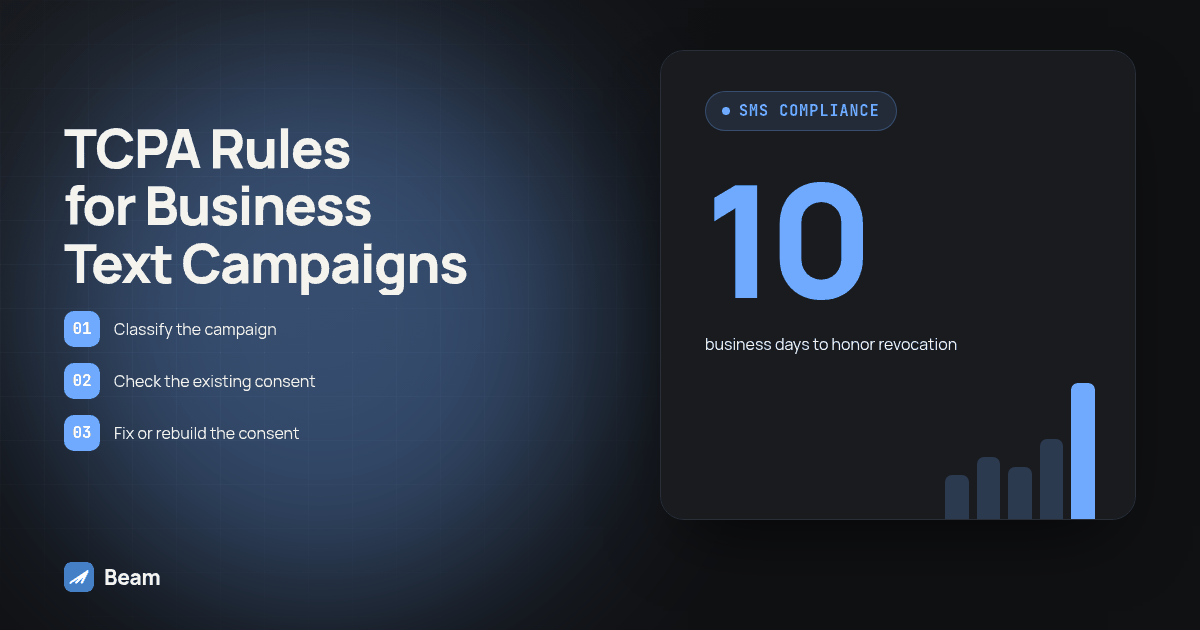
Within a reasonable time from receipt, and never more than ten business days, under the same rule cited above (47 CFR 64.1200). Here is a worked example, assuming no intervening holidays. Say a contact texts STOP on a Thursday afternoon. Counting only business days, Friday is day one, the following Monday through Friday are days two through six, and the Monday after that is day seven. The agency has no later than the Thursday of the second full week to make sure every connected system has stopped sending to that number. In practice almost nothing should take that long: a texting platform should suppress the contact the instant the reply lands, since the block is enforced automatically at the point a message would otherwise go out. Treat ten business days as the legal backstop for the slowest moving part of a client’s own setup, such as a CRM sync step, never as a target pace for the platform itself.
A revocation reaching the agency through a side channel, a call to a receptionist or a note typed into a support form, starts that same clock the moment someone on the team receives it, not when it gets entered into whatever system sends the messages. Build one intake point that every channel reports into so the clock does not quietly start before anyone notices.
What Are The Quiet Hours For Sending Marketing Texts?
The federal rule bars telephone solicitations to residential subscribers before 8 a.m. or after 9 p.m., measured in local time at the recipient’s location, not the sender’s (47 CFR 64.1200(c)(1)). That last clause is the one agencies trip over. A worked example: a Dallas agency schedules a marketing text for 9 a.m. Central. If part of that list lives in California, 9 a.m. Central is 7 a.m. Pacific, well inside the banned window for every Pacific-time recipient, even though the send looks fine from the sender’s own clock.
Some states layer a narrower window on top of the federal rule, so schedule sends inside the tightest window that applies to any state on the list, based on each contact’s own time zone rather than the time zone where the campaign was built. A list spanning multiple time zones needs its send time calculated per segment, not scheduled once for the whole batch.
Marketing Texts vs Informational Texts: How Do The Rules Differ?
This table summarizes ordinary covered autodialed texts; exemptions and other laws require separate review. It shows why one consent checkbox should not blur two purposes.
| Requirement | Marketing or promotional text | Purely informational or transactional text |
|---|---|---|
| Consent needed before sending | Prior express written consent, signed or electronically signed | Prior express consent, which can come from the customer simply providing the number for that purpose |
| Quiet hours apply | Yes, 8 a.m. to 9 p.m. recipient local time | Not required by the federal quiet hours rule, though using the same window is a conservative workflow choice |
| Revocation standard | Any reasonable method, honored within ten business days | Reasonable revocation applies; unrelated informational categories are subject to the limited waiver discussed above |
| Confirmation message after opt out | One confirmation allowed, no promotional content, no additional marketing after that | One nonpromotional confirmation may be allowed; honor the scope of the revocation |
| Typical examples | Sale announcements, promotional offers, a new product launch text | Appointment reminders, order updates, a reply answering a question the customer asked |
Treat that distinction as a design decision, not a legal footnote. Build separate consent captures and sending categories for marketing and informational traffic from the start, so a revocation or quiet hours question only has to be answered for one category at a time.
What’s The Step-By-Step Process Before A Client’s First Campaign Goes Live?
Run this checklist with every new client before their first marketing text goes out, in this order:
- Classify the campaign. Decide whether the text is marketing or purely informational before writing a single word of copy, since that decision sets the consent standard that applies.
- Check the existing consent record. Pull whatever opt-in language the client already has and compare it against the template above. If it does not clearly cover marketing messages in writing, treat the list as unconsented for marketing purposes until it is fixed.
- Fix or rebuild the consent capture. Update the signup form, intake script or point-of-sale prompt so new contacts see language that actually authorizes marketing texts, not just a generic agree-to-be-contacted line.
- Separate the send categories in your platform. Tag or segment contacts by what they actually consented to, so an informational automation and a marketing campaign never pull from the same undifferentiated list.
- Set the send window by time zone, not by office hours. Calculate each segment’s local time before scheduling, and default to the narrowest quiet hours window that applies to any state represented on the list.
- Wire the revocation path end to end. Confirm that a STOP reply, a plain-language request, and any designated opt-out channel all reach the same suppression record, and that the suppression blocks every connected workflow covered by the request, not just the original send.
- Document the review. Keep a dated note of who reviewed the consent language, which rule version it was checked against, and when, so the team has a record to point to later instead of relying on memory.
- Pilot before the full list. Use consenting test contacts to send STOP and a plain-language removal request. Queue a follow-up and verify that each suppressed contact is excluded. Try a send outside the permitted local window and confirm it is held. Save timestamps and outcomes, fix any failure, then pilot with a small consented group before expanding.
Registering a number for SMS traffic is a separate question from any step above. Beam supports iMessage, RCS and SMS. Its iMessage lines do not need A2P registration, while local business SMS needs A2P 10DLC registration, toll free SMS needs verification, and short codes need carrier approval. Carrier registration tells carriers who the sender is; it does not establish consent, and it does not substitute for any step here. If a client’s number still needs that paperwork, our A2P 10DLC registration guide covers that side.
What Happens If A Campaign Breaks These Rules?
The TCPA allows private lawsuits over violations, so counsel should review consent, revocation and timing failures before the campaign resumes. Repeated consent or revocation failures across a list can magnify legal exposure. For the fuller picture of how TCPA consent fits alongside A2P 10DLC registration, toll free verification and HIPAA considerations, see Beam’s texting compliance hub.
Agencies running both calls and texts to the same leads should not treat these as two separate compliance projects. Many of the same consent and timing questions apply to the calling side with their own wrinkles, which RizzDial covers in its guide to TCPA calling hours and consent.
What Do Agencies Still Ask About TCPA Texting Rules?
Does a reply to our first text count as written consent for future marketing texts?
Not on its own. A reply to a question you asked, or an inbound text a lead sent first, answers that one conversation. It does not sign that person up for a recurring marketing campaign. Treat consent for ongoing marketing texts as its own record, collected and worded separately from a single customer-service exchange.
Do business-to-business texts need the same written consent as consumer texts?
The wireless-number restriction does not create a blanket exemption for business recipients. Covered autodialed marketing texts to a business cell number generally need prior express written consent, just as consumer cell numbers do. Ask counsel to assess the sending technology, message purpose and any exemption; a B2B label alone does not settle the question.
What counts as a reasonable method to revoke consent?
More than the word STOP. Replies like stop, quit, end, revoke, opt out, cancel or unsubscribe count automatically, and the FCC’s reasonable-means standard also covers plain language such as please stop texting me, a request made through a channel the business designated for opt outs, and in some cases a request made by phone or in writing. The method does not have to match the channel the message arrived on.
Do the quiet hours apply to informational texts, or only to marketing texts?
The federal quiet hours rule in 47 CFR 64.1200(c)(1) is written around telephone solicitations, which is the marketing category. We still recommend holding purely informational and transactional texts to the same 8 a.m. to 9 p.m. window in the recipient’s local time, because a confused reply from someone woken up by a text is a worse outcome than waiting a few hours.
This is operational guidance, not legal advice. Have counsel review the client’s consent language, sending technology, state rules and campaign plan before launch.