What’s the real difference between a hosted iMessage provider and running your own Apple and Android devices?
Both models can support business conversations, but channel coverage depends on the actual platform and sender configuration. An iMessage setup alone does not establish RCS support or an SMS fallback route. Ask each provider or device operator to demonstrate the channels your clients need, including replies from an Android phone.
A hosted provider operates the sending infrastructure and gives your team access through its software. Available numbers, account setup and onboarding differ between providers. Your agency still has to connect the CRM, assign conversation owners, confirm consent records and test the complete workflow before inviting clients into it.
Running your own devices means your team operates the hardware and accounts. Someone buys or repurposes suitable equipment and keeps it powered, connected and accessible. For using an iPhone number in Messages on a Mac or iPad, Apple specifies an active SIM or eSIM associated with that number and the same Apple Account on the relevant devices (Apple Support: phone numbers in Messages). A Mac by itself does not remove that phone-number activation requirement. Keep business access separate from an employee’s personal account.
How long does each setup actually take before you can text your first client?
Setup time is where the two models diverge the most, and it is the first question most agencies ask.
With a hosted provider, some infrastructure preparation can happen before your agency signs up. That can reduce the work your team performs, but it does not establish a universal launch deadline. Ask about number availability, activation, integration assistance and acceptance testing. Review Beam’s number setup guidance with the team and request a timeline for your actual requirements rather than promising a client a generic turnaround.
Doing it yourself adds hardware procurement, account access, carrier activation and integration work to the launch checklist. The iBluSend comparison of hosted and owned devices presents device ownership as an alternative and describes provisioning effort. It is vendor commentary, not independent evidence of faster setup or better delivery. Neither that comparison nor Apple’s setup instructions establishes a standard warm up period for every business. Schedule launch after your own send, reply and recovery tests pass.
Who owns the phone number: the agency, the client, or the provider?
Ownership sounds like a simple question until a client relationship ends or an agency switches vendors, and then it is the only question that matters.
Running your own device can give you direct administrative control of the carrier account, SIM and Apple Account, provided those records are actually in the business’s control. Physical possession of a phone does not establish an unconditional right to its number. Check the subscriber record, authorized transfer contacts and carrier terms. Keep the account active during a transfer; a port also needs destination support and matching account information.
With a hosted line, assignment, account access and transfer rights depend on the service agreement. Ask whose name appears on the carrier record and who can authorize a transfer if the agency and client separate. Confirm in writing whether the number can be ported out, then read our number porting guide for what moves with a number and what must be rebuilt. The FCC number portability resource provides background, but do not promise a completion date before the receiving provider checks eligibility.
What happens to client conversations when one of our own devices goes offline?
This is the question hosted provider marketing tends to skip, and it is the one that matters most once you are live with real clients.
A workflow that depends on one device can stall if that device loses power, connectivity or account access. What stops depends on the architecture: other signed-in devices or independently supported channels may still work. Map which component handles outbound messages, inbound replies and CRM updates. Do not call the setup resilient until you know what happens when that specific component becomes unavailable.
Isolation is another decision to verify. For example, Tuco AI describes dedicated hardware and separate accounts per client line. That is the vendor’s description of its own service, not a requirement for every device fleet or proof of uninterrupted delivery. Ask both hosted providers and internal operators how clients are separated, who receives failure alerts and how service is restored. A hosted operator takes on infrastructure work, but its systems can still fail.
Write a recovery card for each line: responsible operator, escalation route, affected workflows, safe pause action and evidence required before restarting. A provider contact belongs on that card just as an internal device owner does. During an incident, stop uncertain retries until you know whether the original message arrived. Restoring power is not enough if the CRM still shows the wrong conversation state.
What’s the honest cost tradeoff, beyond the sticker price?
Neither model is simply cheaper. They move the same cost into different buckets, and the bucket that is easy to see is not always the bigger one.
Running your own devices adds hardware, carrier service, software and staff time to the comparison. Include account recovery, updates, replacement equipment and troubleshooting. Owning hardware does not remove recurring service charges or platform restrictions. For either model, ask how sending pace is managed and what happens when a line encounters delivery problems. Beam’s capacity guidance is a starting point for that conversation, not a universal daily allowance or a guarantee against filtering. Confirm the current limits for your intended workflow.
For a hosted service, request the full scope of recurring service, onboarding, support and any usage conditions. Do not assume every provider bundles them the same way. Our business phone number types guide explains the options Beam offers: direct lines, real cell phone numbers, SIP endpoints, toll free numbers, regular local numbers and short codes. These are options to discuss, not a claim that every number type supports every channel. Compare a written hosted quote with the equipment, services and labor your own setup would require.
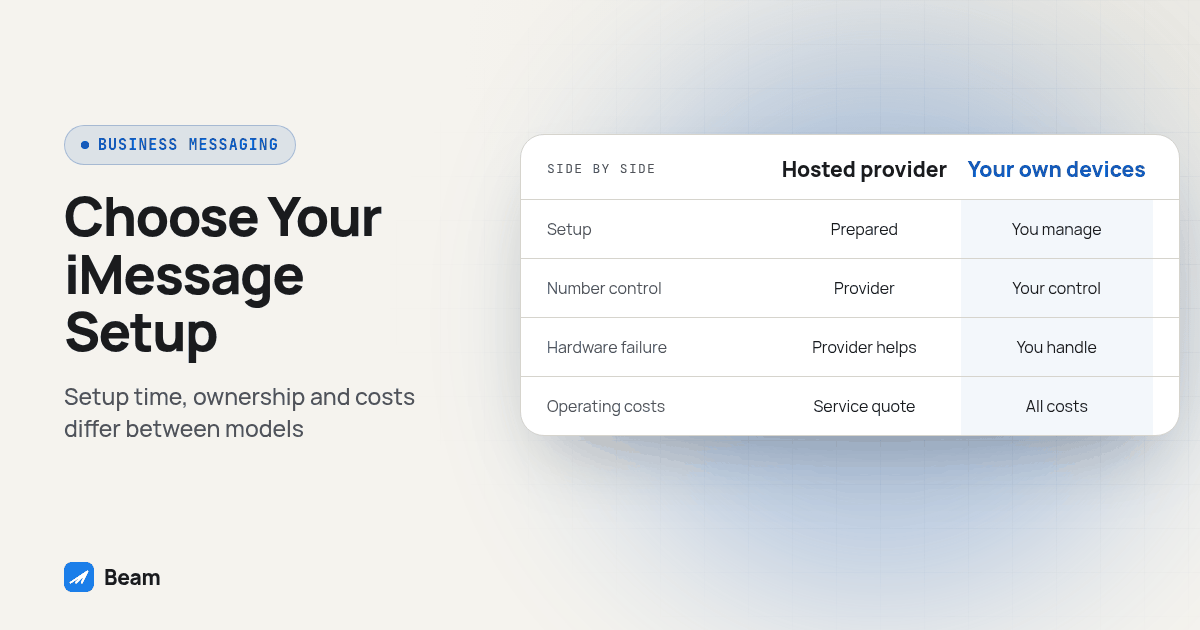
Hosted provider or your own devices: how do the two models compare side by side?
| Decision factor | Hosted iMessage provider | Your own Apple and Android devices |
|---|---|---|
| Setup | Provider prepares infrastructure; verify availability and onboarding | Team handles equipment, account activation and integration |
| Number control | Verify subscriber record, assignment and exit terms | Verify business control of carrier and account records |
| Hardware failure | Provider manages recovery under its support terms; outages remain possible | Team must detect and recover failures in its own architecture |
| Sending pace | Confirm controls and visibility with the provider | Assign responsibility for controls and monitoring |
| Operating costs | Review the full service quote and scope | Include hardware, carrier service, software and staff time |
| More client lines | Check capacity, account separation and provisioning process | Plan equipment, account separation and operational coverage |
| SMS registration | Requirements depend on SMS number type | Device ownership does not remove applicable SMS requirements |
How do we actually decide, step by step?
Work through these five checks in order before picking either model.
- Map the workflow and its owner. List the sender, consent source, CRM trigger, reply destination and person responsible for the conversation. Separate customer-initiated replies from outbound follow-up so the pilot covers both.
- Assign a recovery operator. For owned devices, name the person who can restore power, connectivity and account access, plus a backup. For hosted service, record the support route and ask which recovery actions your team must still perform.
- Build a complete operating worksheet. Record equipment, recurring services, setup work and maintenance hours for the same proposed period. Include replacement equipment and integration support. Ask hosted providers for a quote covering the same workflow.
- Verify the exit path in writing. Confirm transfer eligibility, authorized subscriber, required records and history export options. Check whether the client can continue using the number after leaving your agency. Store the answer with the client agreement.
- Run a one week acceptance pilot. This is a suggested test window, not a promised launch time. Use consented test contacts on iPhone and Android. Send, reply, trigger a CRM action and confirm an opt-out prevents further automated contact. Record the sender, observed channel, timestamps and reply destination. In a controlled test, pause the sending component or ask the provider to demonstrate failure handling, then check for missing or duplicate messages after recovery.
If step two stalls, resolve ownership before adding clients. Save the pilot results in a shared record and have someone outside the implementation check them against the receiving phones. A queued API response alone does not prove delivery. Extend the test if a scheduled reminder, recovery action or client-specific workflow has not been exercised.
Where does a hosted model like Beam fit once you’ve decided?
Beam fits agencies that want a managed messaging layer with iMessage, RCS and SMS, two way sync, MCP and OpenAPI. Beam operates its own infrastructure and offers 24/7 support. Confirm the number, channel and integration requirements for your setup with the team. The iMessage API page explains the integration options; support availability should not be interpreted as an uptime or recovery-time guarantee.
If your agency also needs voice follow-up, review RizzDial integrations when planning the call-to-text handoff. Assign one owner to the next action so a rep and automation do not contact the same person twice. Our provider switching checklist covers the number, history and webhook steps to check when changing platforms.
Beam iMessage lines need no A2P registration. For SMS, local 10DLC numbers need A2P 10DLC registration, toll free numbers need verification, and short codes need carrier approval. Consent and opt-out handling still belong in your workflow regardless of who owns the hardware.
Text our team to try it. Tell us which numbers and channels you need, who handles replies and what your pilot must demonstrate. Ask for a Beam quote based on that scope.
What do agencies still ask before they commit to one model?
How long does it take to go live: a hosted iMessage provider or our own devices?
Neither model has a universal launch time. A hosted provider may have infrastructure prepared, while your own setup requires equipment and account activation. Confirm number availability, integration work and a send-and-reply test before promising a date to a client.
Who actually owns the phone number if we run our own iPhones and Macs?
Your business can control the carrier account, SIM and Apple Account, but owning a device does not establish unconditional ownership of a number. Verify the subscriber record, transfer authorization and carrier terms. For a hosted line, check assignment and porting rights in the service agreement.
What happens to client conversations if one of our own devices goes offline?
A device-dependent workflow may stall until the device or account is restored. Other configured devices or channels may still work. A hosted provider manages its infrastructure recovery, but hosting alone does not guarantee uninterrupted service. Test the failure and recovery path for your setup.
Is it actually cheaper to buy our own devices instead of paying for a hosted line?
Compare the same scope of work in both models. Your own devices require hardware, carrier service, software and maintenance time. A hosted quote should explain service scope and any additional conditions. Neither model is automatically cheaper once the full operating work is included.
Can we switch from running our own devices to a hosted provider later without losing the number?
Possibly, if the destination supports the number and the current account permits the transfer. Confirm eligibility before cancelling service. Preserve conversation history and suppression records separately, then test sending, replies and CRM behavior after the move. A number transfer does not automatically migrate those records.