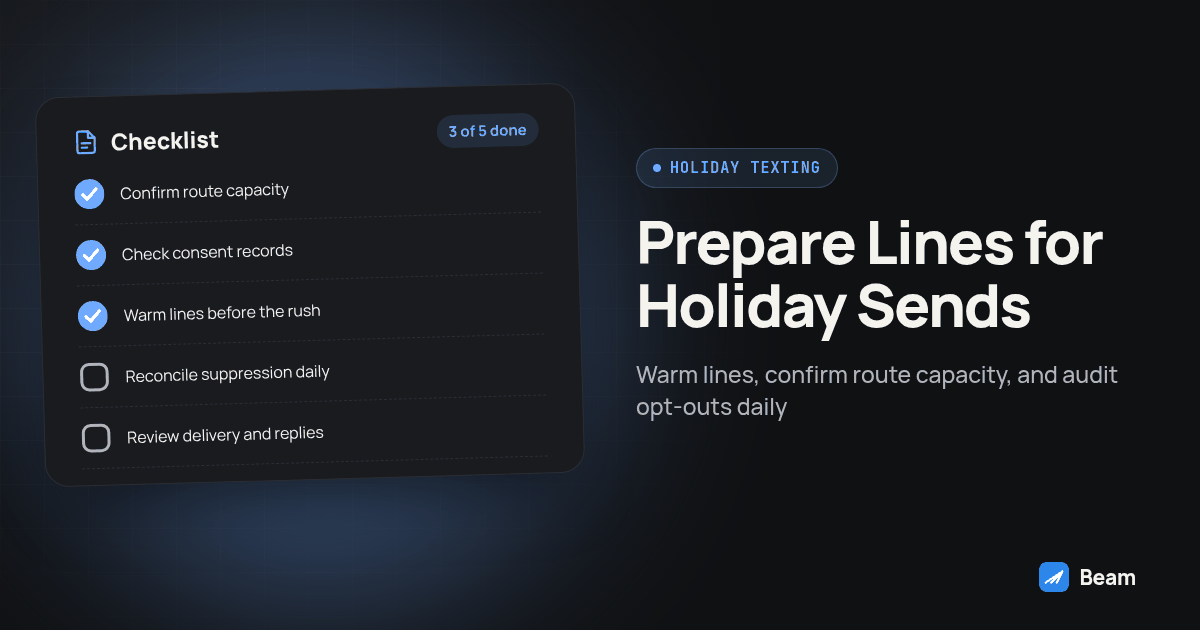
TL;DR: Black Friday through New Year is the one stretch when carriers and Apple see the heaviest combined send volume from every business at once, so the pacing, STOP handling and number health steps that normally run on autopilot need to run tighter and more often. Warm up volume before the rush instead of blasting a cold line on November 27, run the STOP audit daily instead of weekly for six weeks, and schedule around the actual holiday calendar, not just the federal quiet hours floor.
Every agency running client texting has already read a general guide to STOP handling or bulk send volume. This is the version for the six weeks between Thanksgiving and New Year’s, when a client expands the list and sends far more often than usual, expecting the same number that worked fine in September to carry a Black Friday blast without anyone noticing. It usually can, with the right pacing, and usually cannot if the team treats a holiday campaign like any other Tuesday send.
Why is the holiday window actually different from a normal month of texting?
Because every sender is doing the same thing at the same time, on the same shared carrier networks. Thanksgiving falls on November 26 this year, Black Friday on the 27th, Cyber Monday on the 30th, continuing through Christmas and into New Year’s. Twilio names this exact stretch its 2026 Black Friday, Cyber Monday and Holiday Peak Season window, running November 19, 2026 through January 4, 2027, and tells high volume senders to confirm expected volume with their provider by October 31 rather than the week of the send (Twilio, 2026 Heightened Awareness Period).
What changes in that window is capacity and attention, not the underlying rules: opt-out and consent law does not get stricter for the holidays, but the margin for error does get tighter. A suppression gap that affects a handful of contacts in March can affect thousands during a list expansion in late November, and a line never warmed past casual volume gets asked to carry a six week campaign starting the morning after Thanksgiving.
How should a holiday send be paced instead of going out all at once?
Treat the six week window as a ramp, not a launch day. Beam’s own pacing on new outbound-first conversations protects line health, and that mechanic does not pause for a holiday (Beam’s iMessage sending limits guide). A campaign that ignores that pacing and hits the whole list the morning of November 27 works against the same protection that keeps the line usable in December.
Use this sequence starting now, for a Black Friday launch:
- Pull the full holiday list and split it by consent category: promotional opt-in, transactional-only, and unclear.
- Drop the unclear category from the send entirely until it is resolved; a six week revenue window is not the time to test a shaky consent record.
- Pick the lines that will carry the campaign and confirm with the team whether each needs warming or already carries steady volume.
- Run a small pilot to a few hundred contacts from the approved category, and check delivery, replies and early opt-outs before expanding.
- Expand in stages across the week before Black Friday rather than jumping straight to the full list, watching reply and opt-out behavior at each stage.
- Hold the full-list send for Black Friday and Cyber Monday itself, the two days with the most combined sender volume on the network.
- Plan the Christmas and New Year sends as separate stages with their own smaller ramp, not a continuation of Black Friday’s already-expanded pace.
How does the SMS side of a holiday campaign run into a hard daily cap?
Through the same carrier throughput tiers that apply every month, just with more list to push through them. For SMS fallback on a registered A2P 10DLC route, Twilio’s published figures tie throughput to the number’s Trust Score: 75 to 100 gets roughly 225 combined messages per second across the three major carriers, 50 to 74 gets roughly 120, and 1 to 49 gets roughly 12, while an unscored Sole Proprietor campaign is capped at a flat 1,000 messages a day on T-Mobile and 15 a minute on AT&T, regardless of list size (Twilio Help Center, message throughput and Trust Scores).
| Route for the holiday send | What sets the daily ceiling | What a bigger holiday list changes |
|---|---|---|
| iMessage through Beam | Beam’s own line pacing and health, not a published Apple cap | Needs the warm-up and staged expansion above; no A2P registration applies |
| SMS on a vetted A2P 10DLC number | The number’s Trust Score tier at the carrier level | Nothing. The ceiling stays fixed even when the holiday list grows |
| SMS on an unvetted or Sole Proprietor number | A flat per-day or per-minute cap, unrelated to list size | A cold or unvetted number is the single most common reason a holiday blast stalls mid send |
| Short code | The carrier lease and program approval already in place | Opt-out keyword handling still has to run at the higher reply volume, covered below |
That table is the answer when a client asks to “just send the whole list Black Friday morning”: list size does not determine whether the send finishes on time, the number’s registration status and tier do, so confirm the active tier before promising a same-day finish rather than assuming a bigger holiday budget raises a carrier-level cap that has nothing to do with spend.
How do you handle STOP replies when reply volume multiplies for six weeks?
Automate the suppression and shorten the audit cycle, because reading replies by hand stops working once a list and its reply rate both grow together. The industry standard for opt-out handling, set by CTIA’s Short Code Monitoring Handbook, requires a program to recognize the universal keywords STOP, END, CANCEL, UNSUBSCRIBE and QUIT, honor plain language requests like “please opt me out” the same way, send one and only one confirmation message back, and scan inbound message logs regularly for opt-outs that used different wording (CTIA Short Code Monitoring Handbook, v1.9). None of that changes for the holidays; what changes is how often “regularly” needs to mean during a six week push.
For the mechanics of catching keyword and plain language opt-outs and reconciling them against a CRM, the deeper workflow is already covered in our guide to handling STOP and opt-out requests on a business texting line. The holiday-specific addition is cadence. Move the suppression reconciliation to daily from the week before Black Friday through the first week of January, and make sure every other scheduled holiday message for that client, including a separate Christmas or New Year drop, checks the same suppression record, so a contact who opts out of one send does not get the next one. A rising opt-out rate on a single day’s send is an early signal worth pausing and reviewing, rather than waiting for a weekly report. The permitted single confirmation message still has to stay free of promotional content; a confirmation that slips in a sale mention after someone asked to stop is the kind of mistake that gets reported.
What keeps a sending line healthy through six straight weeks of heavier volume?
Treating line health as something to monitor daily during the window, not something checked once in October and forgotten. Beam supports multiple number types for this reason: direct lines, real cell phone numbers, SIP endpoints, toll free numbers, regular local numbers and short codes, giving a large holiday push more than one place to put volume instead of stacking the season onto a single line.
Before the window opens, confirm three things per line: whether it is already warmed to steady volume or needs the staged ramp above, whether the channel mix is iMessage, RCS, SMS or a blend, and what capacity is actually available for the planned audience. Our bulk SMS service guide covers the broader capacity questions for any provider, and our bulk iMessage campaigns guide covers the pilot-first approach for iMessage specifically. Both apply here with one change: run the pilot and capacity check in early November, since there is no slack left to fix a capacity problem on November 26.
During the window, the signal to watch is simple even when the volume is not: delivery, reply rate and opt-out rate per line, checked daily rather than weekly. If a line’s behavior changes mid campaign, Beam’s documented recovery path moves that conversation to a healthy line rather than forcing the degraded one to keep carrying the remaining sends, outlined in the sending limits guide.
What do quiet hours actually mean across Thanksgiving, Christmas and New Year’s?
The legal floor does not move for the holidays, but the practical send-time decision should. The federal quiet hours rule for covered marketing texts still runs 8 a.m. to 9 p.m. in the recipient’s local time, calculated by time zone rather than the sender’s own clock, and our TCPA texting rules guide covers that legal mechanic and its state-level exceptions in depth. What that guide does not cover is the holiday calendar itself: a legally allowed 8 a.m. send on Thanksgiving morning or Christmas Day still lands ahead of family gatherings, cooking and travel, and reads as tone deaf even inside the legal window.
Build the holiday calendar as its own layer on top of the standard quiet hours workflow. Treat Thanksgiving Day and Christmas Day as low-send or no-send days for promotional content, reserved for genuinely time-sensitive transactional messages like an order or appointment update, and schedule the Black Friday and Cyber Monday pushes for late morning in each recipient’s local time zone, inside the legal window but past the earliest allowed hour. Hold New Year’s Eve evening sends to transactional content only, since a promotional text competing with a client’s own evening plans is wasted reach even when compliant. None of that replaces the per-time-zone calculation from the standard workflow; a list spanning several time zones still needs send time computed per segment, holidays included.
The same local-time discipline applies to any calls scheduled around the holidays. RizzDial’s guide to TCPA calling hours and consent covers that mechanic for the calling channel, useful for any agency running texting and calling together this season.
What does a copy-paste checklist for a holiday mass texting launch look like?
Fill this in per client and keep it with the campaign notes, not just in someone’s head:
- Consent reviewed for every list segment, unclear category excluded. Date: ____.
- Lines selected, warm-up status and Trust Score tier (if SMS) confirmed. Lines: ____.
- Pilot sent to a few hundred contacts, delivery and opt-outs reviewed. Pilot date: ____.
- Staged expansion set for the week before Black Friday, full list held for Black Friday and Cyber Monday only. Stages: ____.
- Suppression reconciliation moved to daily, Black Friday week through the first week of January. Owner: ____.
- Holiday calendar layered on the quiet hours workflow: Thanksgiving and Christmas Day low-send, New Year’s Eve evening transactional only. Reviewed by: ____.
- Recovery plan confirmed for a mid-campaign line degrade, including the backup line. Backup line: ____.
Use the money page, Beam’s outbound texting and mass texting guide, to confirm actual available capacity for the planned audience before filling in line 2 above. It plans audience, sending capacity and reply handling together instead of promising a volume number that was never published for the specific route.
Diagram: a six week horizontal timeline from mid-November to early January with a rising-then-flattening line showing send volume, marked with Black Friday, Cyber Monday, Christmas Eve and Day, and New Year’s Eve and Day, and a second overlapping line showing the daily STOP-audit cadence stepping up to daily right before the first marker and back down to weekly after the first week of January.
What do agencies ask us most about holiday mass texting campaigns?
Does a bigger holiday send cost more with Beam, or is pricing the same as the rest of the year?
Pricing is not shown here. Text our team with the client’s audience size, the lines and channels involved, and the current texting workflow, and the team will scope the holiday push directly instead of quoting it off a generic rate card.
If we start planning today, is there enough time to get a holiday mass texting campaign live before Black Friday?
There is no fixed number of days to promise, and the honest answer depends on whether the sending line is already warmed up, whether consent records are current, and whether the workflow has been through a controlled test. Start the warm-up and consent review now, run the pilot this week, and treat the launch date as the output of that work rather than a deadline set first.
If a client’s number gets flagged partway through the holiday rush, is that line gone for good?
Not automatically. Beam’s documented pacing is built to protect line health in the first place, and if a line degrades, the conversation can move to a healthy line and continue. That recovery path exists so a flagged line does not have to mean a lost conversation, but it is not a reason to keep pushing an unhealthy line harder during a high volume week.
Do we need new consent for a holiday campaign, or does the client’s existing marketing list already cover it?
Only if the existing consent record actually covers a holiday promotional send to that list. A contact who agreed to appointment reminders or a single prior campaign did not automatically agree to a new round of holiday offers. Review what each segment agreed to, the channel and the purpose before scheduling, and treat a gap as a reason to leave that segment out of the holiday send rather than assuming an old opt-in stretches to cover it.
Can this holiday pacing and suppression workflow run through a client’s existing GoHighLevel setup?
Yes. Beam connects to GoHighLevel workflows and webhooks the same way the rest of the year, so the holiday version is the same workflow with tighter pacing steps and a shorter audit cycle layered on top, not a separate system to build and then tear down in January.
Six weeks of heavier volume rewards the agency that started the pacing conversation in November, not the one still writing the consent review on the morning of Black Friday. Build the ramp, run the daily audit while it matters, and keep the holiday calendar as its own layer on top of the rules that already govern the rest of the year.