Consider an agency planning reminders for a client with a large contact list. Someone suggests a short code, but list size alone does not tell the team how quickly messages must arrive, what recipients agreed to receive, or who will answer replies. Write those requirements down before committing to a sender. The comparison below is a planning procedure, not a claim about measured customer results or a promise that one number type always launches faster.
What is a short code, actually?
Businesses and organizations lease a short code, a five or six digit number rather than a ten digit phone number, from the short code registry instead of buying it outright (US Short Code Directory). Leasing is only the first step. Each wireless carrier still has to separately approve the specific messaging program that will run on that code, covering the exact keywords, the opt in flow, the message cadence, and the opt out language, before real traffic can move across that carrier’s network.
Approval covers the program submitted for review; it is not blanket permission for unrelated traffic. Do not assume that a new purpose is covered simply because the code is already active. Equally, do not assume that every short code is restricted to a single message type. Ask the provider to document which uses and changes the approved program permits.
When does a short code actually fit a client’s texting program?
The lease and approval overhead earn their keep when a client needs a high volume program with a delivery window that its proposed local number setup cannot meet, and where each recipient opted in to the messages they will receive. Think appointment and bill reminders sent to a large recipient base on a fixed schedule, loyalty or rewards alerts tied to one specific signup flow, or verification codes issued at a scale that makes a dedicated short code identity worth the overhead.
The common thread is a defined program and a documented capacity requirement. Short codes can receive replies: this technical short code overview describes two way messaging. Replies alone do not rule them out. The agency still needs to establish whether staff can handle those replies in the proposed inbox. Use Beam’s business phone numbers guide to compare the available identities before committing to a lease.
When does a local number, toll free number, or direct line fit better instead?
Before choosing another number type in this comparison, ask: what sender identity, sending capacity, and reply workflow does the client actually need?
A local 10DLC number fits a client whose customers already recognize a local area code and who text back and forth, not just receive a scheduled blast. It registers through A2P 10DLC, which identifies the business as a Brand and the use case as a Campaign, a process our A2P 10DLC guide walks through in more detail. National identity needs point toward a toll free number instead: it suits a client who runs a program big enough to want a dedicated review, but still wants the flexibility to handle replies and multiple message types on one sender, through toll free messaging verification rather than short code leasing and carrier approval. Personal relationships point toward a direct line, a dedicated number tied to one rep or team, built for an account manager, a recruiter, or an agent whose customers expect to text the same person back.
Registration does not give any sender unrestricted permission to mix message purposes. For local numbers, match traffic to the registered campaign. For toll free numbers, match it to the verified use case. For short codes, match it to the approved program. The A2P 10DLC overview distinguishes local number registration from toll free and short code routes. These are industry reference documents, not evidence that Beam uses that provider’s infrastructure.
How does the short code lease and carrier approval path actually work?
Leasing a short code is not a single purchase. It runs in stages, and an agency should plan for all of them before promising a client a launch date.
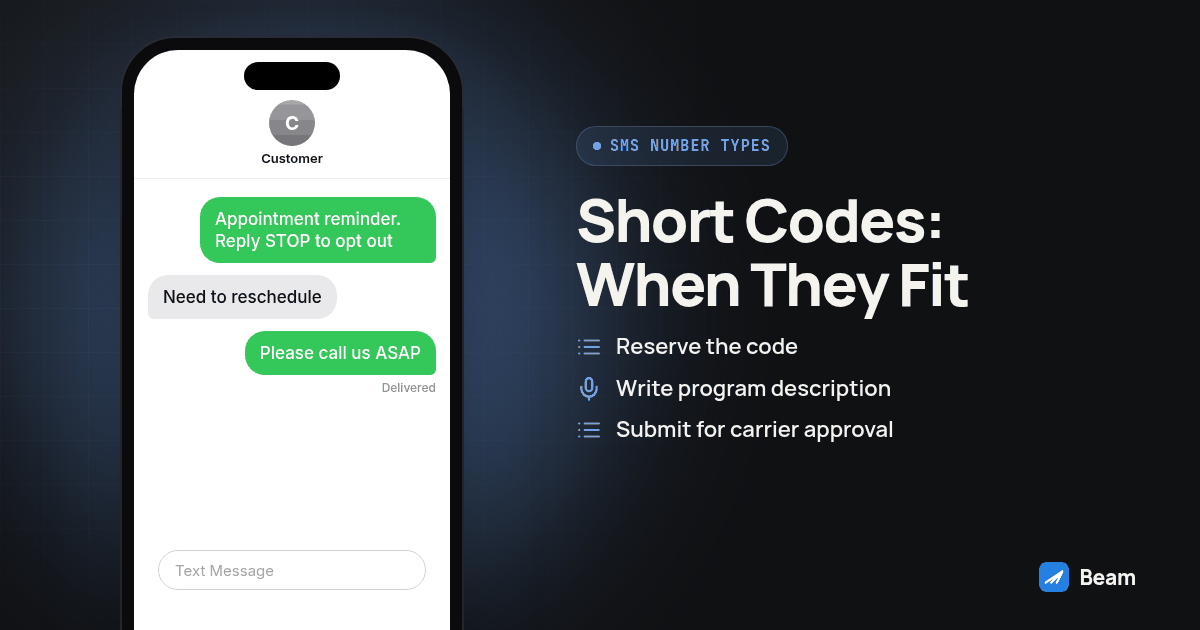
- Reserve the code through the short code registry. The registry assigns either a random short code or, a selected vanity code that a business specifically requests (US Short Code Directory).
- Write the program description the carriers will actually review. This covers the exact opt in method, sample messages, message frequency, and the required opt out and help keywords. Check that the examples agree with the signup disclosure and actual workflow before submission.
- Submit the program for carrier approval. Each major wireless carrier reviews the submission against its own messaging standards; the wireless industry’s own messaging guidance describes the kind of consent, disclosure, and opt out handling carriers expect from any commercial program, short code or otherwise (CTIA’s industry messaging guidance).
- Resolve any requested corrections. A carrier can ask for changes to the opt in flow, the sample message wording, or the frequency disclosure before it approves the program. Build this step into the client timeline instead of assuming the first submission clears.
- Provision the approved code with your messaging platform. Only after approval does the code actually carry production traffic; confirm with Beam that the assigned line and the approved program match before sending to a live list.
- Pilot before the full list moves. Send to a small, consented test group first, confirm delivery, replies, and opt out handling behave the way the approved program describes, then expand.
Treat the lease and the carrier approval as two separate gates, because a leased code with no approved program cannot send the campaign a client is waiting on, and a client timeline built around “the code is ours now” instead of “the program is approved” can leave the agency promising a launch before sending is available.
Short code, local number, toll free number, or direct line: which fits which program?
| Number type | What it is | Approval path | Program scope | Fits |
|---|---|---|---|---|
| Direct line | A dedicated number tied to one person or team | Follows the SMS rules for its underlying number type | Built for ongoing, personal two way conversation | Account managers, recruiters, agents with their own book of clients |
| Local 10DLC number | A ten digit number with a local area code | A2P 10DLC brand and campaign registration | Traffic must match registered campaign | Local service businesses, everyday reminders, two way support |
| Toll free number | An 8XX number recognized nationwide | Toll free messaging verification | Traffic must match verified use case | National support lines, larger programs that still need replies |
| Short code | A five or six digit number | Carrier program approval, plus a lease from the short code registry | Traffic must match approved program | Very high volume alerts, reminders, or verification codes within the approved scope |
How should an agency walk a client through this decision?
- Ask what the client’s customers actually do with the number. Do they reply, or only receive? If they reply, test the actual inbox and staffing workflow. Short codes support replies, but a familiar local or direct line may fit the relationship better.
- Count the distinct message types, not just the total volume. One client running three different programs, like reminders, a loyalty alert, and a support line, needs all intended uses documented. Ask which purposes the proposed registration or approval covers, rather than assuming one sender automatically covers all three.
- Separate the lease decision from the approval decision. Confirm with the client that a leased short code with no approved carrier program cannot send anything yet, so the launch date depends on approval, not on the lease closing.
- Check whether the program is big enough to be worth a dedicated identity. A short code and even a toll free number carry real registration overhead; a client with a modest list is usually better served starting on a local number and revisiting the question once volume actually demands it.
- Write the program description before you submit anything. Draft the exact opt in flow, sample messages, and opt out language the same way the carrier will read it, and have the client sign off on that wording before it goes into any application.
- Pilot on a small, consented list first. Confirm delivery, reply handling, and opt out suppression on the approved program before pointing the full client list at it.
- Document the decision and the reasoning. Record which number type was chosen, why, and what would have to change (volume, message variety, or client preference) before revisiting it, so the next person on the account is not guessing.
What mistakes do agencies make when choosing between these number types?
One avoidable mistake is treating “short code” as a synonym for “serious” or “enterprise,” and recommending one to a client because it sounds more substantial than a local number. Volume and program scope decide the right number type, not how official it sounds on a sales call.
Quoting a client a launch date before checking whether the lease and the carrier approval are two separate steps is a second common mistake. Having a code leased is not the same as having a program cleared to send, and a client who was told “we’ll be live next week” does not want to hear that the approval is still pending.
Assuming a short code’s approval covers whatever the client decides to send later causes a third kind of trouble. If the approved program described reminders and the client later wants to add a promotional blast on the same code, ask the provider whether that change needs an updated application before sending it. Keep the approved program description next to the actual CRM workflow and compare them whenever a client asks to change what gets sent.
Skipping the pilot because the carrier already approved the program rounds out the list. Carrier approval confirms the application; it does not confirm that your CRM workflow, your opt out handling, and your reply routing actually behave the way the application described. Run a small, consented test before the full list moves, the same way you would for any other number type.
What do agencies still ask before committing to a short code?
How much does it cost to lease a short code?
Lease and setup costs are set by the short code registry and the aggregator handling approval, not by Beam, and they vary by whether the code is randomly assigned or a selected vanity number. Ask your aggregator for its current lease and setup terms before you quote a client, and never promise a client a number until that quote is in writing.
How long does carrier approval for a short code take?
Carrier approval timelines are set by each carrier’s own review process and change over time, so we do not quote a fixed number of weeks here. Plan the lease and the approval as two separate steps, start the application well before the client’s launch date, and confirm the program is actually approved and tested before you schedule a go live date.
Does a short code still need A2P 10DLC registration?
No. A2P 10DLC registration applies to ten digit local numbers. A short code goes through its own carrier program approval and lease instead, and a toll free number goes through toll free verification instead of either one. Pick the number type first, then follow that type’s own registration path.
Can we move a client off a short code and onto a local number later without losing the program?
Not automatically. A short code, a local number, and a toll free number present different sender identities to recipients. Review the original consent record and provider migration requirements to determine whether renewed consent or a sender change notice is needed. Preserve opt outs, update workflows, and test the new sender before moving the full program.
What integrations does a short code program need that a local number program doesn’t?
A short code program needs CRM sending, reply routing, and opt out handling just like other texting programs. Keep those workflows aligned with the approved use cases, keywords, and disclosures. Ask the provider whether a proposed change needs review before changing the live workflow, and retest the affected messages and replies afterward.
Compliance rules differ by number type, and short codes sit alongside toll free verification and A2P 10DLC as three separate paths under the same overall framework; our texting compliance guide lays out how consent, opt out, and quiet hours apply across all three so the number type decision and the compliance decision stay connected instead of getting handled by two different people on the account. If the client’s real question is toll free versus local rather than short code versus everything else, our toll free vs local number guide walks through that narrower comparison in more detail. The same discipline applies on the calling side of a client’s number: RizzDial’s guide to local presence dialing rules for agencies covers how agencies should plan caller ID and local presence decisions before turning a feature on for a client, which is the voice equivalent of the texting number type question above.
A short code should solve a documented capacity or campaign identity requirement. Pick the number type that matches what the client’s program actually does, not the one that sounds the most impressive in the pitch deck. If you want help mapping a specific client’s volume and message mix to the right number type before you lease anything, tell Beam’s team what you’re building and we will help you work through the choice.