What should a business require from a text messaging service before trusting it with client conversations?
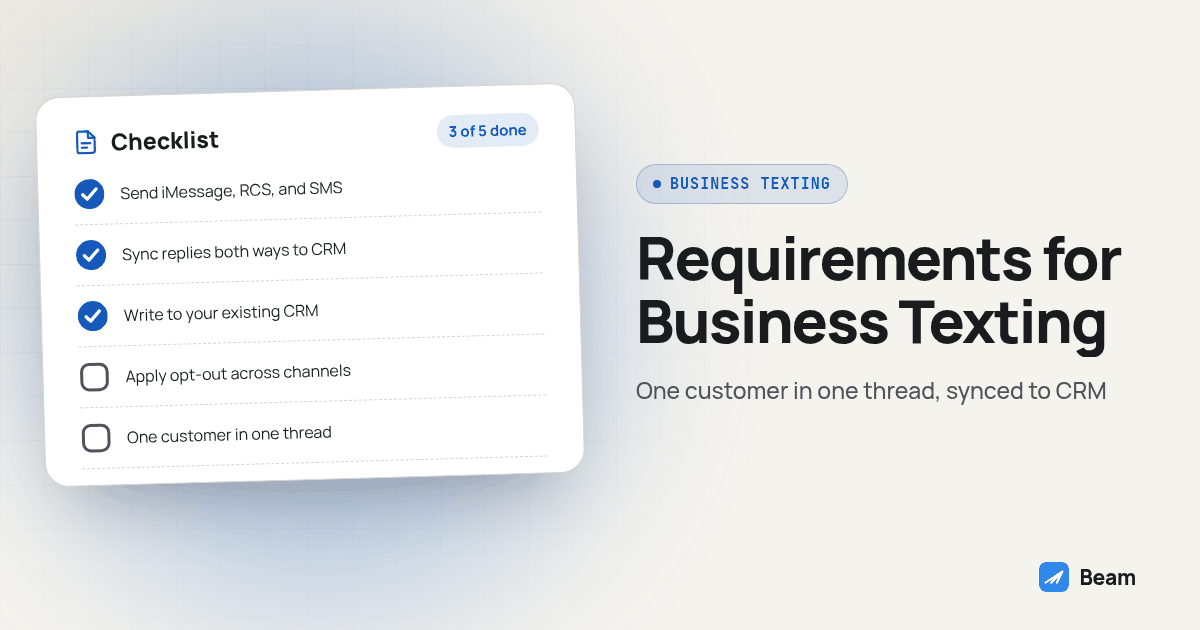
Boil it down to five requirements. For this agency checklist, require iMessage for eligible iPhones, RCS where supported, and SMS fallback where available. An SMS-only service may fit a narrower brief; record that difference before comparing providers. It has to sync replies into a shared inbox and a CRM in both directions, not just log outbound sends. It has to write that history into the CRM you already run your pipeline on, with the right contact matched every time. It has to apply an opt out across every channel the moment it happens, not just the one it arrived on. And it has to keep one customer in one thread, even when two staff answer on different days. Everything below is a proposed acceptance test you can run with a vendor. It is not a report of measured customer results or a promise that every integration handles these cases automatically.
Does it send iMessage to iPhones and fall back to SMS without you managing two systems?
Start with the channel question, because it decides whether your proposed workflow fits the client’s audience. Apple’s comparison of iMessage, RCS, and SMS/MMS distinguishes the channels available in Messages. A familiar app does not mean every conversation uses the same transport. Apple’s separate Messages for Business program is not evidence that a vendor offers an official iMessage integration.
Beam offers iMessage, RCS and SMS. Its route depends on sender and recipient capability: iMessage for eligible iPhones, RCS for supported Android recipients, and SMS fallback where available. Ask the vendor to show which route actually handled each test message, rather than inferring it from a successful send screen. Read the iMessage for Business page when planning the test.
Do not use airplane mode as proof that SMS fallback is broken. An unreachable phone can be unable to receive either route, and an uncertain delivery result is not a confirmed channel failure. Agree on a supported fallback test with the vendor, keep the receiving phone connected, and check both the message record and the phone. Record the sending number too, so a route change does not introduce an unexpected identity.
No A2P registration is required for Beam iMessage lines. SMS rules still depend on number type: local 10DLC numbers need A2P 10DLC registration, toll free numbers need verification, and short codes need carrier approval. Review the number and registration requirements before testing SMS. Channel choice does not replace consent or opt out handling.
Does it sync replies in both directions, not just outbound sends?
Sending is the easy part, since it only requires the platform to know who to message and what to say. Receiving is the part that takes real engineering, because a reply landing on a device or a short code has to be picked up, matched to the right contact, and pushed back into wherever your team is actually watching before anyone can act on it.
Test this directly rather than trusting a feature list. Reply from your test phone and time how long it takes for that reply to show up in the shared inbox the vendor sells you, and separately, how long it takes to show up in your CRM. Those are sometimes two different clocks, because a platform can have a fast internal inbox and a slow or incomplete CRM write-back. Then do the reverse: answer from inside the CRM and confirm the message actually reaches the customer’s phone, not just a queued status screen that looks like success. A business texting app worth putting a client on should make both directions boring and predictable, not something your team has to babysit.
Does it write into the CRM you already run your pipeline on?
A texting platform that lives entirely in its own dashboard creates a second source of truth, and a second source of truth is where client handoffs go wrong. The sync has to write into the CRM record your sales and support team already opens every day, with the contact matched correctly, the direction and timestamp accurate, and any attachment carried along, not dropped.
This is also where agencies get surprised, because a texting integration and a CRM workflow trigger are two separate wires even when they look like one feature. Writing a message into a conversation thread is a sync problem. Firing a tag, moving a pipeline stage, or starting a follow-up sequence off that message is a second step, built on purpose against a specific event, usually a new inbound message or an opt out, not a scheduled check that reads the record late. GoHighLevel’s own inbound message API documentation treats this as a supported integration path, but supported does not mean automatic for every provider that claims to connect. The same discipline applies to lead source data generally: a CRM for service businesses needs retrievable evidence behind every field, not a populated dropdown, and a texting sync is one more place that evidence quietly breaks if nobody tests it.
In an isolated test workspace, use a duplicate contact on purpose. Create the same test contact twice in the CRM, once with a country code on the phone number and once without, then send from the texting platform and check whether it matches the existing contact or creates a second one. A platform that silently splits history across two contact records will hand your client an incomplete picture of their own customer, and nobody will notice until a closer asks why big chunks of the conversation are missing.
Does it handle opt outs the way regulators and carriers expect?
An opt out needs a documented path from the receiving inbox to the workflows that can send again. The FCC’s 2024 consent revocation order recognizes reasonable ways to revoke consent, including standard reply words (FCC 24-24). Use STOP and a separate plain-language request such as please stop texting me in your test. A keyword-only demonstration does not establish that staff can recognize and act on other requests.
Treat immediate suppression across the client’s connected texting workflows as an operational acceptance criterion. Do not infer a universal legal scope or deadline from this checklist. Applicable rules depend on the message and circumstances; have the responsible reviewer confirm the program’s obligations. This is a workflow test, not legal advice.
Test it like any other critical path. Text the word STOP from a phone you control and confirm the suppression applies immediately, before the next scheduled send goes out. Then check whether that opt out event is visible on the CRM side too, not only in the texting platform’s dashboard, because an agency managing several client numbers needs the suppression to follow the contact everywhere. Read the plain-language version on the texting compliance page, and treat a vendor who cannot show the opt out reaching both systems as untested.
Does every customer end up in one thread, not three?
A customer should never have to repeat themselves because the agent who answered today cannot see what a different agent said last week. That sounds obvious until you watch it happen in a real agency account: one rep answers from the shared inbox, another replies to the same number from inside the CRM, and the two interfaces each show a partial version of the conversation because they were never actually reading the same thread.
Confirm this by opening the identical conversation on two staff screens at once and watching whether a new message appears on both, in the same order, or whether one screen lags or shows a stale copy. Also check what happens after an agency-client handoff, since a client taking over a number needs the full history to move with it, not just the number. One customer, one thread, one history, regardless of who is looking, is the actual bar, not whether the platform calls itself a shared inbox.
How do we test a texting vendor before we hand it to a client?
Use this ten-step pilot before giving a vendor live client traffic. Work with phones you control and a CRM contact nobody else is actively working. Capture the message identifier, channel, sender, contact record and timestamp at each step. Agree on acceptance criteria and an owner for failed tests before starting.
- Message a test number from an iPhone and from an Android phone, and confirm which channel each one actually receives: iMessage, RCS, or SMS.
- With the vendor, configure an SMS-eligible test where RCS is unavailable but the phone remains reachable. Confirm the documented fallback behavior and record any explicit failure; do not treat airplane mode as a fallback test.
- Reply from the test phone and time how long the reply takes to land in the shared inbox, then separately time how long it takes to land on the matching CRM contact.
- Reply from inside the CRM and confirm the message reaches the test phone, not just a queued status in the dashboard.
- Open the same test conversation on two staff logins at once and confirm both see the identical thread and order, not two drifting copies.
- Create a duplicate contact record with the phone number formatted two different ways, then send a message and check whether the platform matches the existing contact or splits the history.
- Text STOP from the test phone and confirm the suppression applies before the next scheduled message fires.
- Check that the opt out event is visible on the CRM side, not only inside the texting platform’s own dashboard.
- Ask whether the vendor exposes a status event for each message, such as queued, sent, delivered, and failed, so a workflow can branch on the real outcome instead of guessing.
- Wait a week, then pull the full conversation history for the test contact and confirm nothing from either channel silently disappeared, and that every timestamp matches what actually happened on the phone.
Complete the immediate checks first, then finish the later history check before signing off the pilot. A week-later retention check cannot pass in an afternoon. For each failure, record who will fix it, what evidence will demonstrate the fix, and which steps need repeating.
What should the checklist look like on paper?
Turn the ten steps into something you hand a vendor during a sales call, and write down what you observed next to each line instead of a verbal yes.
| Requirement | How to verify it | What a fail looks like |
|---|---|---|
| iMessage, supported RCS and SMS fallback | Use reachable controlled phones and an agreed SMS-eligible fallback case | Route or failure is not explained in the message record |
| Two way sync | Reply from the device, then from the CRM, and time both directions | One direction works, the other lags or never arrives |
| CRM write back | Match a duplicate contact in two phone formats | Platform creates a second, split contact record |
| Opt out handling | Text STOP and check suppression on both the platform and the CRM | Suppression only applies inside the texting tool |
| One thread per customer | Open the same conversation on two staff logins at once | Screens show different messages or different order |
Keep a copy of this next to the outbound texting planning guide when you are deciding how much volume a given line and workflow can actually carry once a vendor passes the pilot.
What should a clinic verify beyond the texting checklist?
HHS says the Security Rule does not require an organization to obtain an external compliance certification. That does not remove other obligations. Its business associate guidance explains when written assurances and agreements are required. Review the actual service relationship and data handling with the practice’s privacy lead. Carrier infrastructure alone does not settle that review.
Use fictional patient details for the pilot. Decide who can see replies, where sensitive questions should go, and what staff should do when a patient sends more information than a scheduling conversation needs. These decisions belong in the rollout record alongside the technical test results.
What do agencies still ask before they switch?
How long should it take to get a business texting line synced into our CRM?
Ask for a live test in the proposed configuration rather than a universal setup deadline. Send a message, find the reply on the correct contact, and confirm the intended workflow event. Credentials, contact mapping and custom work can change the setup effort. Record what is ready and what still needs implementation before promising a client a launch date.
Who gets billed when a client's texts run through a CRM like GoHighLevel and a separate texting platform?
Ask for a written responsibility map covering the CRM account, messaging line, sending usage and integration support. These may be supplied separately or bundled. Confirm who owns each account and who responds if sending stops. Do not assume that a CRM subscription includes every messaging service connected to it.
What happens to our CRM conversation history if we switch texting vendors?
Retention and migration depend on the CRM, provider and account settings. Confirm which messages remain accessible after disconnection, what can be exported, and how the replacement integration maps contacts. Save an authorized sample conversation before cutover and compare it afterward. Do not assume that switching vendors automatically transfers or merges old threads.
Does a texting vendor need to be HIPAA approved before a clinic can text patients?
A certification label does not replace a review of the actual patient messaging workflow. Beam supports HIPAA compliant texting through compliant carrier infrastructure. The practice still needs its own safeguards, including consent, access controls and limiting message content. Have the privacy reviewer determine whether business associate requirements apply and verify the necessary agreements before sending patient information.
Does an iMessage line count as marketing consent the same way an SMS campaign does?
No. An iMessage line is a channel, not a consent record. Do not treat a customer inquiry as blanket permission for promotional campaigns. Document the permission applicable to each message purpose, keep the record accessible to the sending workflow, and honor opt outs across the connected texting process.