TL;DR: On a plan that includes messaging, a customer generally will not see a special charge just because a business sent the message. But the recipient’s own carrier plan still controls charges: SMS and RCS use the plan’s messaging terms, while iMessage uses Wi-Fi or cellular data and may incur data charges. The business number type does not create a universal billing rule, so check the customer’s plan when they need a definite answer.
We get a version of this question from agencies almost every time they are about to flip a client’s texting line over to iMessage: will this make my client’s customers think something is wrong, or worse, will it cost them money and create a support ticket before the first campaign even sends? Below is the practical answer, the search wording that surfaces this concern, how iMessage and carrier messaging differ, and the number type decision that matters once the billing question is clear.
Does an iMessage business number cost the customer anything extra?
Usually, the sender’s identity does not add a special surcharge to the recipient’s bill. The recipient’s plan determines how incoming SMS or RCS is treated. For example, Verizon says messaging is included at no additional charge on its unlimited and shared data plans, and directs customers on other plans to check their account terms (Verizon messaging FAQ). That is a plan-specific example, not a promise about every carrier or plan. A Trumpia explainer on toll free texts similarly qualifies its guidance to plans that include texting. Text-Em-All explains that carrier and aggregator fees apply to business sends while consumer messaging can be bundled into a mobile plan (SMS and MMS billing overview). Apple says iMessage messages do not count against SMS, MMS, or RCS allowances, while cellular data rates may apply when it uses mobile data (Apple iMessage overview).
The sender number type does not tell you the recipient’s plan terms. A local number, toll free number, short code, or iMessage-capable line can reach a phone through different channels, but the customer’s plan and network conditions determine whether the recipient has any charge. Avoid promising that every plan treats every channel identically.
Why does this question even come up, if the answer is this simple?
Because the worry is real enough that people type it into Google. We checked Google’s autocomplete suggestions for “imessage business number” directly, and two of the four returned completions are exactly this concern: “do imessage numbers show up on bill” and “imessage registered numbers” (checked via Google autocomplete, November 2026). That is not a huge search volume signal on its own, but it is a direct line into what a skeptical customer, or a cautious agency client worried on that customer’s behalf, actually types when they are not sure whether to trust a new texting line.
The underlying anxiety usually traces back to one of three things: a customer remembers getting billed per text in the pre-smartphone era, a customer is on an older or international plan where texting is not unlimited, or an agency client has heard the words “toll free” or “short code” and assumes those carry some kind of premium rate like a 900 number used to. All three are reasonable things to wonder about and all three resolve the same way once you look at how carriers actually itemize texting today.
How do carriers actually bill texting, by number type?
Here is the practical breakdown an agency can use to explain the channel differences. “Bill treatment” describes the usual plan mechanism, not a guarantee for every customer:
| Number type | How it reaches the recipient | What shows on the recipient’s bill | What the business has to set up first |
|---|---|---|---|
| Regular local number | SMS, or RCS where supported | Depends on the recipient’s plan; many plans bundle messaging | Applicable A2P 10DLC registration for business SMS |
| Toll free number | SMS, or RCS where supported | Depends on the recipient’s plan; many plans bundle messaging | Toll free verification for business SMS |
| Short code | SMS at high volume | Depends on the recipient’s plan | Carrier program approval and a short code lease |
| iMessage-capable line | iMessage over data or Wi-Fi to eligible iPhones, SMS fallback otherwise | Nothing; iMessage does not draw from the texting allotment at all | No A2P registration for the iMessage conversation itself; SMS fallback still follows the rules for that line’s underlying number type |
Beam offers six number types for exactly this reason: direct lines, real cell phone numbers, SIP endpoints, toll free numbers, regular local numbers, and short codes, each suited to a different sending pattern (see our business phone number types guide). The number type does not override a recipient’s plan. What changes for the sending business is the registration or verification it may need before business messaging can go out. Explain those as sender-side requirements, and keep them separate from the recipient’s own plan charges.
Does the “A2P 10DLC” or “toll free verification” paperwork mean the customer pays more somehow?
No. Keep the sender’s setup requirements separate from the recipient’s plan charges. A2P 10DLC registration is a brand and campaign identity check that a business completes with its number provider before sending application-to-person texts from a local number. Toll free verification is the equivalent check for toll free numbers. Short codes need a lease and a carrier-approved program. Our step by step A2P 10DLC registration checklist and our short code versus number types guide both walk through what each process actually requires.
These processes concern the sender’s ability to send business messages, not a surcharge added to a recipient’s account. An unregistered number may have messages filtered or blocked. iMessage itself is a separate internet messaging service, while any SMS fallback remains subject to the requirements for its underlying number type.
What should we actually tell a nervous client about their customer’s bill?
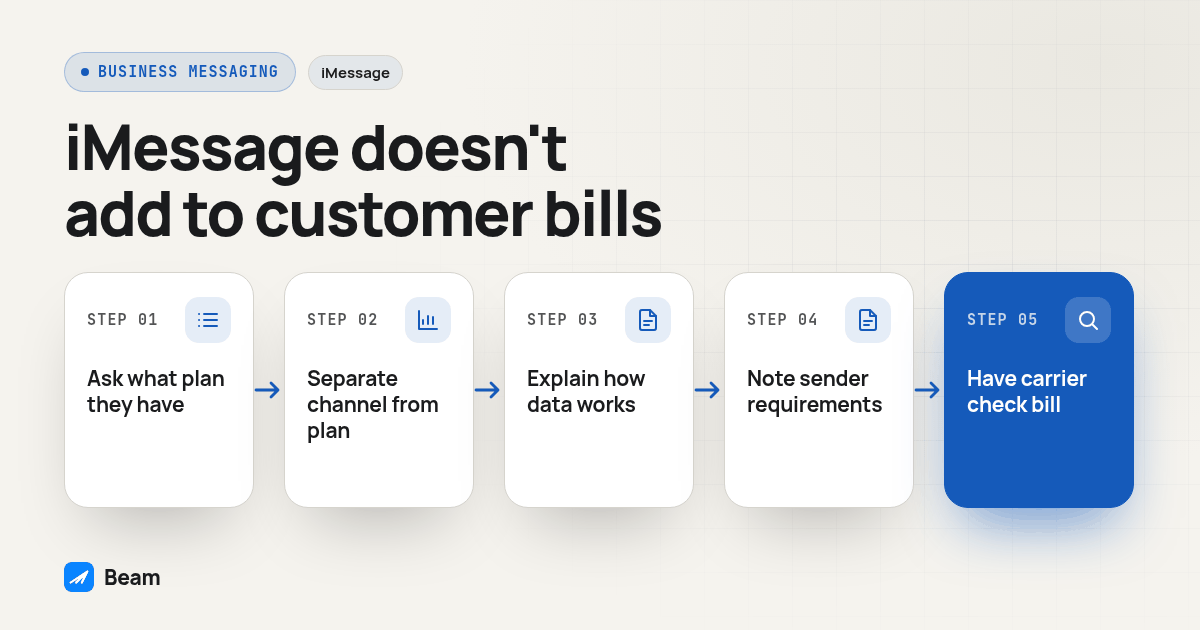
Use this five step procedure when an agency client raises the question before launch. It gives the team a careful answer without claiming to know a customer’s individual plan:
- Confirm which plan type the question is about. Ask whether they mean SMS, RCS, or iMessage, and whether they are at home or roaming. Plan allowances and data terms differ. Apple notes that iMessage can use Wi-Fi or cellular service and cellular data rates may apply. For a plain-language overview of carrier treatment, see the Trumpia billing explainer.
- Explain that inbound is free regardless of channel. Whether the message arrives as a blue iMessage bubble, a green RCS bubble, or a plain SMS, the recipient’s carrier does not bill for receiving it on a texting-inclusive plan, per both carrier billing explainers cited above.
- Point out that iMessage specifically uses data, not texting minutes. It rides over Wi-Fi or mobile data, and the amount of data one text thread uses is negligible, far less than a single photo shared over email.
- Separate the registration question from the billing question. If the client is asking about A2P 10DLC or toll free verification, explain that these are sender setup requirements. Use our A2P 10DLC checklist to answer that separate question.
- If a specific customer disputes a charge, send them to their own carrier. Beam and the agency control what gets sent and from which number; neither controls a customer’s individual plan or billing dispute, so the right next step for an actual billing complaint is always the customer’s own carrier, not the texting platform.
How is this different from the toll free versus local number decision?
The recipient’s bill is not a reliable reason to choose between local and toll free numbers because the customer’s plan determines message treatment. Our toll free versus local number guide covers practical considerations such as whether customers recognize a local area code, whether the client needs a national identity, and which verification path applies. Choose a number based on the business’s communication needs and setup requirements, then explain that recipient billing depends on their own carrier plan.
Where does this leave an agency setting up a new iMessage line today?
Clear to move forward on the billing question, and clear on where to focus instead. A business number does not itself guarantee a particular customer bill. The useful next steps are to identify the message channel, make sure the sending business has completed the applicable registration, and direct account-specific billing questions to the recipient’s carrier. For iMessage, explain the cellular-data caveat alongside the fact that it does not use SMS, MMS, or RCS allowances.
If the client’s broader sales operation needs the same kind of plain-facts cleanup beyond texting, MetaTechAi’s AI infrastructure work covers how service businesses set up the systems underneath their sales team.
Text our team if an agency wants a second opinion on which number type fits a specific client’s volume and channel mix before launch.
What do agencies ask us most about iMessage business numbers and billing?
Does a customer get charged for receiving a text from a business iMessage number?
It depends on the customer’s plan and connection. iMessage does not count against SMS, MMS, or RCS allowances, but Apple says cellular data rates may apply. For SMS or RCS, check the recipient’s messaging plan.
Will the business number show up as a strange or unfamiliar line item on the bill?
The sender’s number may appear in the phone’s message thread or carrier usage details, depending on the carrier and account. Whether messages are itemized on a bill varies by plan and carrier, so check the customer’s account for a definite answer.
Is iMessage billed differently from SMS because it uses the internet instead of a carrier text plan?
Yes, the delivery method differs. iMessage uses Wi-Fi or cellular data and does not count against SMS, MMS, or RCS allowances. Apple says cellular data rates may apply when iMessage uses mobile data.
Why does a toll free or short code number sometimes get flagged by carriers as suspicious before a customer ever replies?
That concerns the sender’s approval and delivery, not a recipient surcharge. Toll free business texting may require verification, and short codes require carrier approval. These steps do not determine the recipient’s plan charges.
Does switching a client from SMS to an iMessage business line change anything on the customer’s side at all?
The conversation can look different and use a different delivery method. Eligible iMessage conversations appear in Apple’s Messages app, and cellular data rates may apply when using mobile data. Whether the recipient pays for SMS or RCS depends on their carrier plan.