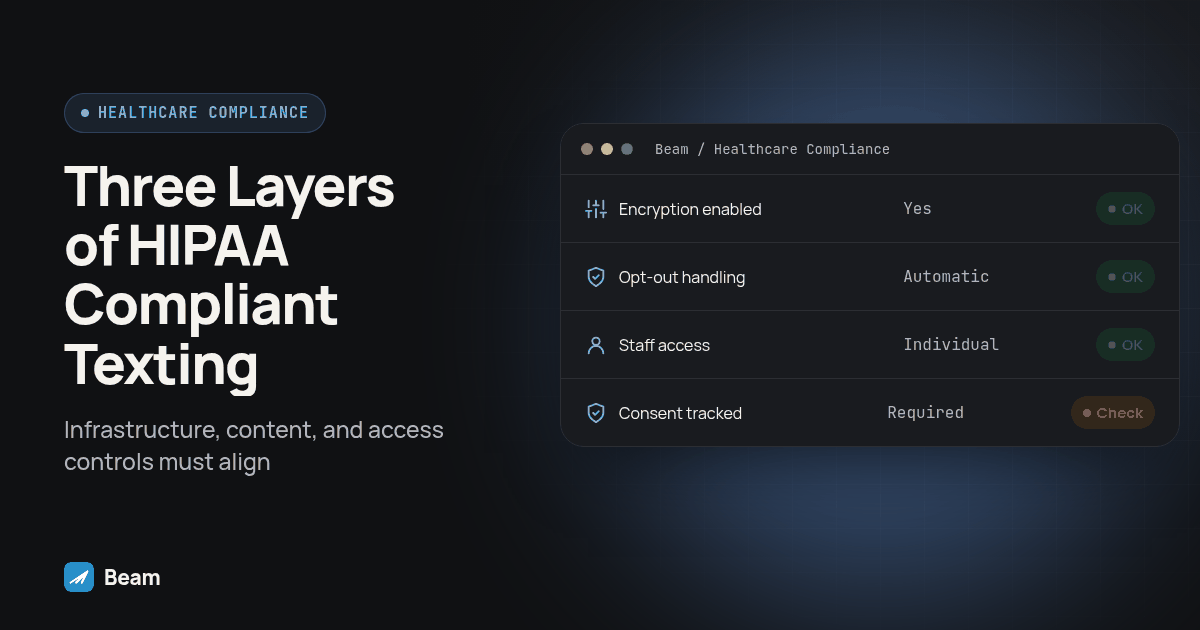
TL;DR: Compliant carrier infrastructure handles the sending: encryption in transit, carrier level safeguards, and a business associate agreement if the vendor offers one. It does not decide what the message says, who consented to get it, or which staff member can open the thread. Beam supports HIPAA compliant texting through compliant carrier infrastructure, and has never claimed any certification under HIPAA, any third party audit, or a signed business associate agreement. The rest of the job, minimum necessary content, consent records and access controls, stays with the practice.
A text message is HIPAA compliant when three separate things line up at the same time: the carrier and platform routing it run compliant infrastructure, the message content stays inside the practice’s own minimum necessary policy, and the practice controls exactly who can read and send from that thread. Picking a texting vendor only settles the first piece. The other two land on the office manager, the privacy officer, or whoever owns compliance at the practice, on day one and every day after that vendor contract is signed.
What actually makes texting HIPAA compliant, beyond the carrier?
Three layers, stacked on top of each other. The bottom layer is infrastructure: does the carrier encrypt messages in transit, does the platform have reasonable technical safeguards, and will the vendor sign a business associate agreement if protected health information is going to touch its systems. That layer is necessary. It is also the easiest one for a vendor to market, because it is the part a product demo can show.
The middle layer is content. HIPAA’s Security Rule tells covered entities to assess their own size, infrastructure and risk, then choose safeguards that match that assessment instead of leaning on a vendor’s feature list (45 CFR 164.306). In practice, for a texting program, that means deciding what belongs in a routine message before a single template goes live, not after a patient replies with something the thread was never built to hold.
The top layer is access and consent: who can open a thread, how a patient agreed to receive it, and what happens the moment someone wants to stop. A platform cannot decide any of that on a practice’s behalf. During vendor review, teams can easily focus on infrastructure first and leave content and access questions unanswered. Put those questions on the same review checklist before a workflow goes live.
What does Beam support, and what does it stop short of claiming?
Beam supports HIPAA compliant texting through compliant carrier infrastructure. That is the exact claim, and it is worth being precise about what sits outside it. Beam does not claim any certification under HIPAA, any third party audit, or a signed business associate agreement, because none of those is on file. Any vendor that tells a buyer otherwise is making a claim that should be confirmed in writing before a single patient message goes through that line.
What Beam does handle automatically on the infrastructure side: STOP, unsubscribe, cancel and similar opt out replies block all future sends to that contact right away, with the API returning an error on a blocked attempt. Sending follows pacing limits instead of late night bursts or a day one blast from a brand new number, and each contact stays on one consistent thread rather than scattering across numbers (Beam’s compliance overview). None of that is a HIPAA feature by itself. It is carrier and platform behavior that keeps a line looking legitimate to the networks carrying it, which is a different job from deciding what a clinic should type into a confirmation text.
What stays the practice’s job, according to that same overview: consent (who actually agreed to be texted, and at what number), content (what the practice says and whether it belongs in a text at all), and identity (making sure a new patient knows who is texting them). A vendor can make all three easier to manage. None of them can be outsourced entirely.
What does “minimum necessary” mean for a routine patient text?
HHS describes the minimum necessary standard as a requirement that covered entities limit the protected health information they use or disclose to the amount reasonably needed for the purpose at hand (HHS minimum necessary guidance). Translated into a texting template, the question is simple: does the patient need this specific clinical word to act on the message, or would the same message still work with it removed.
“You are confirmed for Tuesday at 2 at our Main Street location” gives a patient everything needed to show up. It does not need a procedure name attached to do its job, and a reminder naming a diagnosis sits on a lock screen the same way a plain one does, just with more to lose if the wrong person reads it first. Run every template through that filter before it reaches a real list, not after a complaint.
| Covers it | Compliant carrier infrastructure | The practice’s own job |
|---|---|---|
| Encryption in transit | Yes | No |
| Carrier level sending safeguards (pacing, opt out enforcement) | Yes | No |
| Business associate agreement, if one is offered | Depends on the vendor | Confirming it in writing |
| What the message says (minimum necessary content) | No | Yes |
| Who consented, and to what | No | Yes |
| Which staff can read and send from a thread | No | Yes |
| Training staff on the handoff when a patient replies with clinical detail | No | Yes |
Who should actually have access to a patient texting thread?
Limit sending and reply access to the staff who already handle scheduling and patient calls, not the full front desk roster by default. Every teammate should have an individual login rather than a shared one, and a thread should be assignable to a specific person so two people are not answering the same reply or missing it entirely. When someone leaves, that login needs to stop working immediately, not at the end of the pay period.
Screenshot: A side by side of Beam’s inbox showing one active staff login next to one deactivated login, with the thread owner field visible on an open conversation, to show what an access control review actually looks at.
The same review should ask a second question: when a patient texts back something clinical, what happens next. Route that reply to a staff member instead of letting any automated workflow answer in kind, and pause automated sending on that thread until a person has looked at it. A platform that supports a human handoff makes this easier to run consistently. It still takes a written rule and a staff member who follows it.
How do consent and communication preference change the picture?
Appointment and scheduling consent is a different record from marketing consent, even when the same patient gave both. Log the exact wording a patient saw at intake and the date they agreed to it, and keep that record separate from however the practice collects newsletter or promotional opt in elsewhere (Beam’s consent and opt out guide). Mixing the two records together is a common and avoidable source of confusion later, especially once a patient opts out of one but not the other.
Opt outs need to work regardless of phrasing. STOP and its usual variants work automatically on a compliant platform, and plain language requests like “please stop texting me” have to be honored the same way, since a request made through any reasonable method now counts as valid rather than requiring an exact keyword. Frequency matters on top of that: a narrow federal exemption lets healthcare providers send certain treatment related messages without the consent otherwise required for autodialed texts, but only under specific conditions, including a cap on messages per day and per week combined with calls, no marketing or financial content, and opt out instructions included every time (47 CFR 64.1200(a)(9)(iv)). That is a narrow exemption for a specific message type, not a blanket rule for every patient text a practice sends, so confirm which basis actually applies with counsel before relying on it.
What should a practice check before signing with any texting vendor?
Run this sequence before a contract gets signed, not after the first campaign goes out:
- Ask the vendor directly whether a business associate agreement is available, in writing, and read what it actually covers before assuming the answer is yes.
- Pull every active or proposed text template and strip anything beyond scheduling logistics: diagnosis, procedure name, test result, or billing and insurance detail.
- Separate appointment consent from marketing consent in your own records, with the exact wording the patient saw and the date they agreed to it.
- Test the opt out path twice: once with an exact STOP reply, once with an ordinary sentence asking to stop, and confirm both actually suppress future sends.
- Send a test clinical reply from a phone the team controls and confirm a named staff member gets it, not an automated workflow answering in kind.
- Review staff access against the current role list, confirm each login is individual, and confirm a deactivated login stops working right away.
- Get sign-off from the practice’s privacy officer or counsel on the approved templates, the consent basis, and the access list, with the date and reviewer recorded.
A clean pass on the confirmation template does not carry over to a recall campaign or a different message type. Each one needs its own run through that same list, because the content changes even when the vendor and the carrier behind it do not.
For sample wording built around that same filter, the front desk texting checklist has confirmation, reminder and recall templates already trimmed to logistics only, and the dental patient texting guide covers the same review for recall and reactivation campaigns specifically. For the registration and carrier side of the stack rather than the content side, Beam’s texting compliance hub covers A2P, toll free verification and the HIPAA basics in one place, and Beam’s dental texting page applies the same split to a dental practice’s own templates.
What do clinic and agency buyers ask about HIPAA compliant texting?
Does picking a HIPAA compliant texting vendor make our practice HIPAA compliant automatically?
No. A vendor’s carrier infrastructure covers the sending: encrypted transit, carrier level safeguards, and in some cases a signed business associate agreement if the vendor offers one. The practice still owns its minimum necessary content rules, its consent records, and who on staff can read and send from a patient thread. Compliance is the sum of all three, not just the one the vendor controls.
Will Beam sign a business associate agreement for our practice?
Beam supports HIPAA compliant texting through compliant carrier infrastructure. Beam does not claim any certification under HIPAA, any third party audit, or a signed business associate agreement, because none is on file today. Confirm in writing what any vendor, including Beam, actually offers before protected health information goes through a line, and keep clinical content out of the thread until that question has an answer.
Can a texting platform really be certified under HIPAA?
HIPAA compliant describes an ongoing practice built on safeguards, policies and training that a covered entity runs and maintains. There is no formal process for a texting platform to get certified under HIPAA, because no federal agency issues that kind of approval. A vendor that advertises one is describing something that does not exist as a government credential, which is itself a reason to ask more questions before signing.
If our front desk is already texting patients without a real compliance review, what do we fix first?
Start with content, not the vendor. Pull every active text template and strip anything beyond scheduling logistics: diagnosis, procedure name, test result or billing detail. Then separate appointment consent from marketing consent in your records, confirm STOP and plain language opt outs both work, and lock down who has a login to send or reply. Switching platforms later is easier once those three things are already clean.
None of this is legal advice. Have the practice’s privacy officer or counsel review the actual templates, consent language and access list before a patient texting program goes live. For the call and text handoff on the voice side of a clinic’s patient outreach, agencies running both channels together can see how that pairs with outbound calling in RizzDial’s guide to AI dialers for medical practices.
What do clinic and agency buyers ask about HIPAA compliant texting?
Does picking a HIPAA compliant texting vendor make our practice HIPAA compliant automatically?
No. A vendor's carrier infrastructure covers the sending: encrypted transit, carrier level safeguards, and in some cases a signed business associate agreement if the vendor offers one. The practice still owns its minimum necessary content rules, its consent records, and who on staff can read and send from a patient thread. Compliance is the sum of all three, not just the one the vendor controls.
Will Beam sign a business associate agreement for our practice?
Beam supports HIPAA compliant texting through compliant carrier infrastructure. Beam does not claim any certification under HIPAA, any third party audit, or a signed business associate agreement, because none is on file today. Confirm in writing what any vendor, including Beam, actually offers before protected health information goes through a line, and keep clinical content out of the thread until that question has an answer.
Can a texting platform really be certified under HIPAA?
HIPAA compliant describes an ongoing practice built on safeguards, policies and training that a covered entity runs and maintains. There is no formal process for a texting platform to get certified under HIPAA, because no federal agency issues that kind of approval. A vendor that advertises one is describing something that does not exist as a government credential, which is itself a reason to ask more questions before signing.
If our front desk is already texting patients without a real compliance review, what do we fix first?
Start with content, not the vendor. Pull every active text template and strip anything beyond scheduling logistics: diagnosis, procedure name, test result or billing detail. Then separate appointment consent from marketing consent in your records, confirm STOP and plain language opt outs both work, and lock down who has a login to send or reply. Switching platforms later is easier once those three things are already clean.